If your CCTV still records but the picture is poor, remote access is unreliable, or key areas are full of blind spots, the usual question is straightforward: can you upgrade old CCTV without replacing everything? In many cases, yes. A full rip-out is not always necessary. The right answer depends on what you already have, how it was installed, and whether the system still meets the level of security your property or business needs.
For many sites across Essex, London and the South East, older CCTV systems are a mixture of parts added over time. You may have analogue cameras on ageing coaxial cable, a recorder with limited storage, or a system that works locally but offers no useful mobile access. That does not automatically mean starting again. Quite often, a professional survey will show that some parts can stay in place while the weak points are upgraded first.
Can you upgrade old CCTV without replacing everything on most sites?
Usually, yes – but only if the existing infrastructure is worth keeping. The biggest saving often comes from reusing cabling, containment, brackets, mounting positions, and in some cases a serviceable recorder cabinet or network arrangement. If those elements are sound, an upgrade can be completed in stages with less disruption and lower upfront cost.
That said, keeping old parts for the sake of it can be a false economy. If a system suffers repeated faults, poor image quality at night, incompatible equipment, or unreliable power supplies, patching it up may simply delay a more sensible replacement. Security systems need to perform when something actually happens, not just when they are tested on a quiet day.
What parts of an old CCTV system can often be kept?
Older systems are rarely all bad. In many properties, the cabling is still one of the most valuable elements. Existing coaxial cable can sometimes support modern HD-over-coax cameras, which means image quality can improve dramatically without reopening walls or replacing every run. For some commercial premises, that can reduce installation time and keep disruption to staff, tenants or customers to a minimum.
Camera positions can often be reused as well. If your original layout was sensibly designed, there may be no reason to move every device. A better camera in the same location can deliver clearer facial detail, improved number plate capture, or stronger low-light performance without changing the wider system design.
Power supplies and housings may sometimes remain, although these should be tested rather than assumed to be suitable. Older power units can become unstable over time, and that sort of hidden issue is often behind intermittent camera failures.
The parts most commonly upgraded first
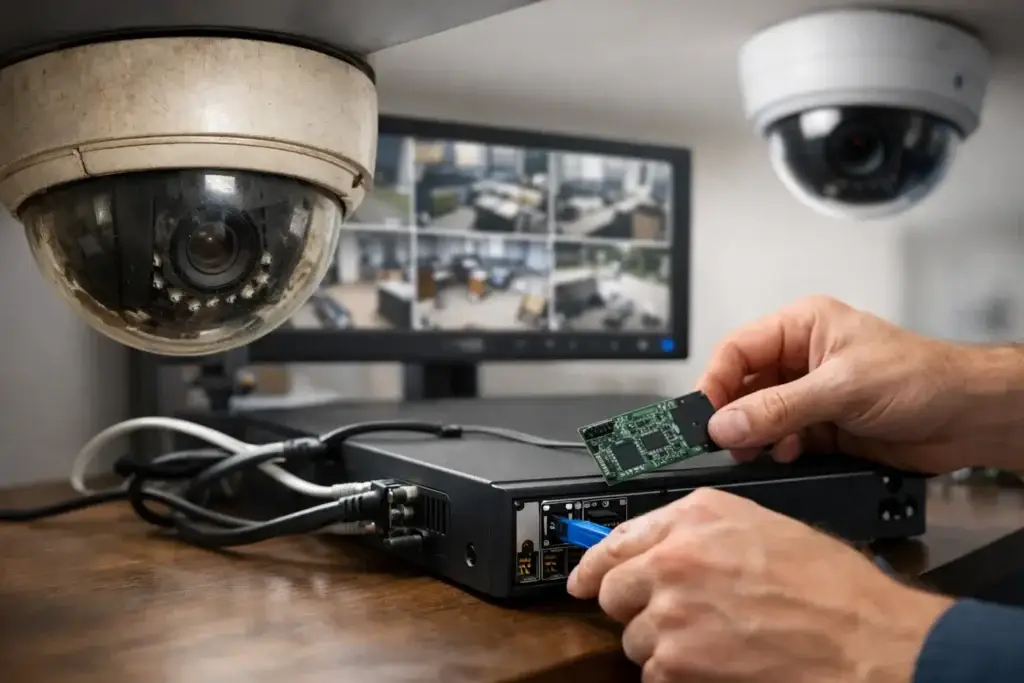
The recorder is often the first place to look. An old DVR or NVR may be the reason the whole system feels dated. Limited storage, low recording resolution, poor search functions and weak remote viewing are common complaints. Replacing the recorder while keeping compatible cameras can be a practical first step, especially if you need longer retention periods or easier footage retrieval.
Cameras are the next common upgrade. A site might have working cameras that are no longer good enough for identification purposes. Grainy images, poor infrared range and narrow coverage can all undermine the value of the system. Upgrading selected cameras at entrances, tills, loading bays, car parks or access points can improve the quality of evidence without replacing every camera on site.
Sometimes the issue is not image quality but capability. Many older systems do not support useful analytics such as line crossing alerts, intrusion zones, people counting or vehicle detection. If your security needs have changed, that capability may matter more than simply increasing resolution.
When a partial CCTV upgrade makes sense
A staged upgrade is often the right approach when the site is large, the budget needs to be managed over time, or the existing system still has some serviceable components. Retail units, schools, industrial sites and blocks of flats often fall into this category. The goal is to improve the parts that matter most first, rather than replace functioning equipment with no immediate operational benefit.
This approach also works well where a business cannot tolerate major downtime. If surveillance needs to remain active throughout opening hours, works may need to be planned around trading, shift patterns or access restrictions. Reusing infrastructure can make that easier.
There is also a practical insurer and compliance angle. Some customers need a security upgrade that supports current risk requirements without waiting for a full capital project. In that situation, targeted improvements can bridge the gap, provided the resulting system is still properly designed and fit for purpose.
When replacing everything is the better decision
There are times when the honest answer is no – you should not try to upgrade piecemeal. If the cabling is degraded, cameras are failing, the recorder is obsolete, and the system was badly designed from the start, keeping fragments of it may cost more over the next few years than replacing it properly now.
The same applies where your security needs have changed significantly. A small analogue system installed years ago for a house or corner shop may not be suitable for a multi-entrance commercial site, a logistics yard, a construction project or a property requiring remote management and event-based alerts. If the system architecture no longer matches the risk profile, a full redesign is usually the safer option.
Cyber security can be another factor. Some older internet-connected devices no longer receive updates and may present unacceptable risk if left in service. For businesses handling sensitive environments, that matters.
Analogue to IP – do you need to change everything?
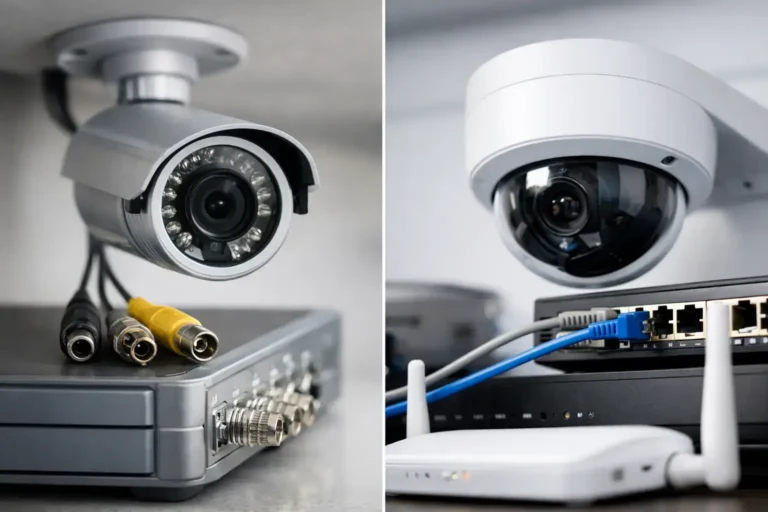
Not always. One of the most common upgrade questions is whether moving from analogue to IP means a full replacement. Sometimes it does, particularly if you want network-based cameras, advanced analytics, flexible remote access and higher scalability. But there are middle-ground options.
HD-over-coax technology can provide a major step up from older analogue systems while keeping suitable existing cable. That can be a strong option for homes, small businesses and certain commercial sites where the infrastructure is in decent condition and the priority is clearer footage rather than a complete networked redesign.
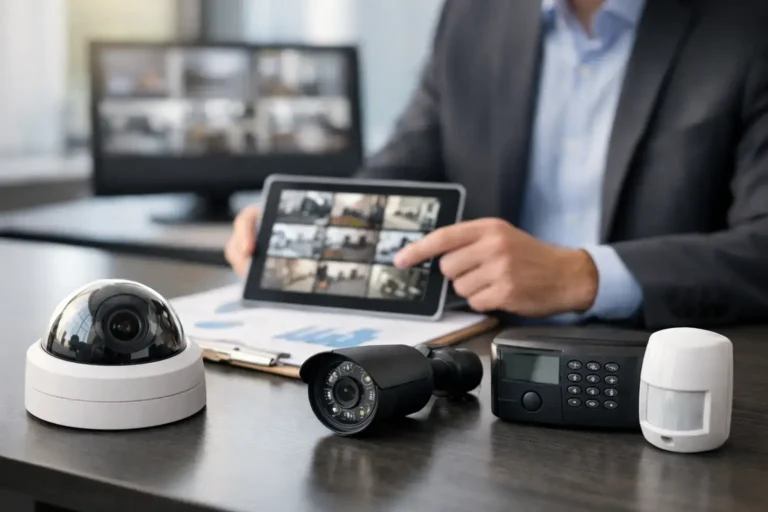
An IP upgrade becomes more attractive where you need broader integration with access control, intruder alarms, remote monitoring or multi-site management. It also tends to suit growing businesses better, because adding cameras and changing layouts is often easier within a properly designed IP environment.
The risks of upgrading the wrong way
The main problem with ad hoc CCTV upgrades is compatibility. Mixing cameras, recorders and transmission methods without a proper design can leave you with reduced functionality, unstable recording or image quality that does not match expectations. A cheaper short-term fix can create a more expensive system to maintain.
There is also the issue of coverage. Many older systems were installed when expectations were lower. A camera that once counted as acceptable general monitoring may now be useless for identifying a suspect, reading a registration plate or investigating a health and safety incident. Upgrading equipment without reviewing actual coverage can miss the real problem.
That is why a professional assessment matters. It is not just about whether old components still power on. It is about whether the system does the job it needs to do now.
How to assess whether your old CCTV can be upgraded
Start with the purpose of the system, not the hardware. Are you trying to deter trespass, monitor staff and visitors, protect stock, oversee vehicle movements, or secure a home when unoccupied? The answer affects whether a staged upgrade is practical.
Then assess image quality, storage, night performance, remote access and reliability. If one or two areas are clearly underperforming, a partial upgrade may be sensible. If every area is compromised, replacement is usually more cost-effective.
It also helps to look at age and supportability. If key parts are obsolete and spares are difficult to source, keeping them in place may create unnecessary risk. For insurer-recognised and professionally maintained systems, long-term reliability matters as much as purchase price.
For that reason, many customers ask for a site survey before making a decision. A proper survey can identify what is reusable, what should be changed now, and what could reasonably wait until a second phase. That is often the most practical route for both homeowners and businesses that want to improve protection without overspending.
At 247 CCTV, this is usually where the value of specialist advice becomes clear. A good installer will not push a full replacement where it is not needed, but they should also be prepared to say when keeping old equipment would compromise the result.
If you are wondering whether your current system is worth upgrading, the best answer comes from looking at performance, compatibility and risk together. Old CCTV does not always need to be replaced wholesale. But the right upgrade should leave you with a system you can rely on when it matters, not one that simply looks cheaper on paper.