When the mains fail, emergency lighting has one job – to come on immediately and guide people to safety. If it does not, the consequences can be serious for staff, visitors, residents and anyone responsible for the building. That is why one of the most common compliance questions we hear is how often test emergency lighting systems should be carried out, and what those tests actually involve.
The short answer is this: emergency lighting should usually be function tested every month and fully duration tested once a year. That said, the right approach depends on the type of premises, the risk level, the system design and who is responsible for maintenance. A small residential block and a busy commercial site do not always need the same level of oversight in practice, even though the broad testing framework is well established.
How often to test emergency lighting in the UK
For most premises in the UK, emergency lighting should be checked monthly with a short functional test and annually with a full rated duration test. These expectations are widely understood in line with British Standards guidance and general fire safety responsibilities.
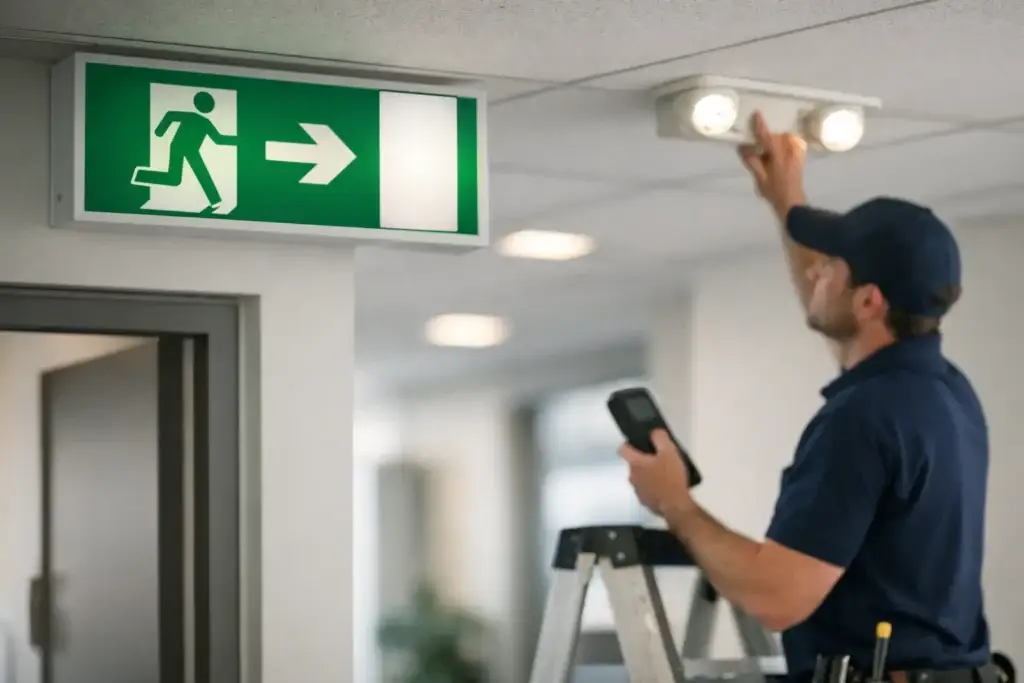
A monthly test is there to confirm that each fitting operates when normal power is interrupted. In simple terms, you simulate a mains failure and make sure the light comes on. This is not a long discharge test. It is a brief check to confirm the fitting, lamp and battery are capable of switching into emergency mode.
The annual test is more demanding. Each luminaire should operate for its full rated duration, which is commonly three hours, though some systems differ. This checks battery capacity, not just whether the fitting lights up for a few seconds. A unit that passes a monthly flick test can still fail the annual duration test if the battery has deteriorated.
Why testing frequency matters
Emergency lighting is often forgotten because it sits quietly in the background until there is a power cut, fire alarm activation or emergency evacuation. Unlike CCTV, intruder alarms or access control, there may be no daily interaction with the system. That makes a planned testing regime even more important.
Batteries age. Chargers fail. Lamps degrade. Dust, damage and building alterations can all affect performance. If a corridor layout changes, a fire exit route is repositioned or partition walls are added, a system that was originally compliant may no longer provide suitable coverage.
Testing is not just about ticking a compliance box. It is about proving that escape routes, stairwells, changes in level, final exits and open areas remain usable when visibility drops and normal lighting is lost.
What happens during the monthly test
A monthly emergency lighting test should be brief and controlled. The aim is to verify operation without unnecessarily draining the batteries. In many buildings this is done by using a test key switch or test facility that simulates failure of the local lighting circuit.
During that test, a responsible person should confirm that each relevant fitting illuminates, that exit signs are visible, and that there are no obvious faults such as flickering, physical damage or units failing to respond. Once the mains supply is restored, you should also check that fittings return to normal charge condition where indicators are fitted.
This sounds straightforward, but on larger sites it can become time-consuming. Warehouses, schools, offices, HMOs, blocks of flats and mixed-use premises often have more fittings than people realise. Missing even a small section of the building can leave a gap in protection.
What the annual duration test involves
The annual test is the one that tends to cause the most disruption, because the system has to run on battery power for its full design duration. In many cases that means three hours. During this period, the person carrying out the test should confirm that the fittings remain illuminated for the required time and continue to provide sufficient light to escape routes and key safety points.
At the end of the test, any failed components should be identified and replaced. This may include batteries, lamps, control gear or complete fittings where older units are no longer economical to repair. The system then needs enough time to recharge fully.
Timing matters here. A duration test carried out during occupied hours can create unnecessary risk if the batteries are left depleted and there is a later incident before recharge completes. For that reason, annual testing is often scheduled out of hours or during quieter periods.
Who is responsible for emergency lighting tests?
In commercial premises, responsibility usually sits with the responsible person, duty holder, employer, managing agent or facilities team, depending on the building and how it is managed. In residential blocks and rented buildings, landlords or managing agents may be responsible for communal areas. On construction sites, temporary facilities and changing layouts create an added need for regular checks.
The law does not expect every duty holder to be an emergency lighting engineer. It does expect them to ensure the system is maintained and suitable. In practice, that often means simple routine checks can be handled in-house if the person is competent, while annual servicing, fault diagnosis and remedial work are better dealt with by qualified specialists.
This is where many sites benefit from working with one provider that already supports their wider fire and security systems. A business managing CCTV, access control, fire alarms and emergency lighting together is usually in a stronger position than one trying to coordinate multiple contractors with separate records and attendance schedules.
Records matter as much as the test itself
A test that is not recorded may as well not have happened when questions are asked after an incident, insurer query or fire risk assessment review. A proper log should show the date of the test, who carried it out, which areas or fittings were checked, whether defects were found and what remedial action was taken.
For monthly checks, the record can be simple but should still be clear. For annual tests, more detail is sensible, especially where failures were identified. If a battery pack is replaced in one area but several neighbouring fittings are of the same age, that may indicate wider ageing across the system.
Good records also help with budgeting. Emergency lighting faults rarely appear all at once. More often, failures start gradually as components reach end of life. A documented history makes it easier to plan replacement before compliance becomes a problem.
Common reasons emergency lighting fails tests
Battery failure is the most common issue, especially on older fittings. Rechargeable batteries lose capacity over time, and a fitting that illuminates briefly may still fail to hold for the required duration. Physical damage is another frequent cause, particularly in plant rooms, loading areas, schools and shared residential spaces.
Poor maintenance after refurbishments also catches people out. Ceiling changes, circuit alterations or decorative works can leave test switches inaccessible or fittings disconnected. In some properties, the system technically works but no longer covers the current escape routes properly because the internal layout has changed.
There is also the problem of assuming a new installation will look after itself. Even newer LED emergency lighting requires routine testing. LEDs reduce some maintenance burdens, but they do not remove the need to prove that batteries, charging circuits and emergency operation all function correctly.
Self-testing systems still need oversight
Some modern emergency lighting systems include self-test functionality. These can automatically perform scheduled checks and indicate faults through status LEDs or a central panel. They can save time, especially on larger sites, but they are not a reason to ignore the system.
Someone still needs to review the fault indications, keep records and arrange repairs. Self-test systems can improve efficiency, but only if the reports are acted on. A flashing indicator that nobody investigates is not compliance – it is just a warning being ignored.
When you may need more than the minimum
Monthly and annual testing is the standard baseline, but some buildings need a more hands-on approach. High-risk premises, sites with vulnerable occupants, 24-hour operations and buildings with complex escape routes may justify more frequent inspection of certain areas. The same applies where there is a history of faults or poor maintenance.
If your property has frequent power issues, heavy usage, harsh environmental conditions or ongoing refurbishment works, it is sensible to review the testing regime rather than follow the minimum blindly. The safest approach is to match maintenance to the actual risk profile of the building.
For businesses across Essex, London and the South East, that often means treating emergency lighting as part of a wider life-safety and security strategy rather than a standalone annual obligation. 247 CCTV regularly sees how building systems overlap in practice, especially where fire alarms, access control and emergency routes all need to perform together under pressure.
A well-maintained emergency lighting system rarely gets any attention on an ordinary day. That is exactly how it should be. The value shows itself in the few seconds after the power fails, when people need clear, reliable guidance without hesitation. If you are unsure when your last test took place, that is usually the right time to arrange the next one.