At 11:17 on a normal school day, there is no time for debate about who should ring whom, which classroom phones still work, or whether a message has reached the sports hall. That is where a school lockdown system case study becomes useful. It turns a broad safeguarding discussion into something practical – what happened, what failed, what improved, and what other schools can learn before they face a serious incident of their own.
For education settings, lockdown is not a theoretical policy sitting in a folder at reception. It is a live operational procedure that depends on communication, access control, staff confidence and speed. A strong system is not simply an alarm button on the wall. It is a coordinated response designed around the layout of the site, the age of pupils, the movement of visitors and the reality that schools are busy, noisy places where messages can easily be missed.
What this school lockdown system case study shows
In this case study, imagine a medium-sized secondary school in the South East with around 1,100 pupils, a sixth form block, detached sports facilities and a mix of old and newer buildings. The school had a written lockdown policy and regular fire alarm testing, but its emergency communication arrangements had grown piecemeal over time. Reception could send emails, staff had mobile phones, and some departments used radios, but there was no single lockdown trigger and no reliable site-wide notification method.
That gap came into focus after two separate incidents. The first involved an aggressive parent refusing to leave reception and moving deeper into the building before senior staff intervened. The second was an off-site police incident nearby that required the school to secure pupils quickly during lunchtime, when many were outside or moving between buildings. In both cases, staff responded well personally, but the systems around them were too dependent on individual judgement.
The school needed more than a louder bell. It needed a lockdown solution that could initiate a clear instruction across the whole site, restrict movement where appropriate, support phased responses, and work even when parts of the campus were operating independently.
The risks the school had to address
Like many education sites, the risk was not limited to one extreme scenario. The leadership team had to plan for several possibilities, including an intruder on site, a local police incident, a safeguarding concern involving a non-custodial adult, or a violent confrontation spilling over from the public highway.
Each risk demanded slightly different action. A full lockdown might require doors to secure immediately and a site-wide spoken announcement. A partial lockdown might only affect one block while the rest of the school continued under close control. That distinction matters. If every incident triggers the same response, staff can lose confidence in the procedure, and disruption becomes harder to justify.
The school also faced a common operational problem: the buildings did not all lend themselves to one neat solution. Some classrooms had access-controlled doors. Others relied on mechanical locks. The sports hall and temporary classrooms were further away from reception, which meant any delay in communication created a weak point.
The system design and why it worked
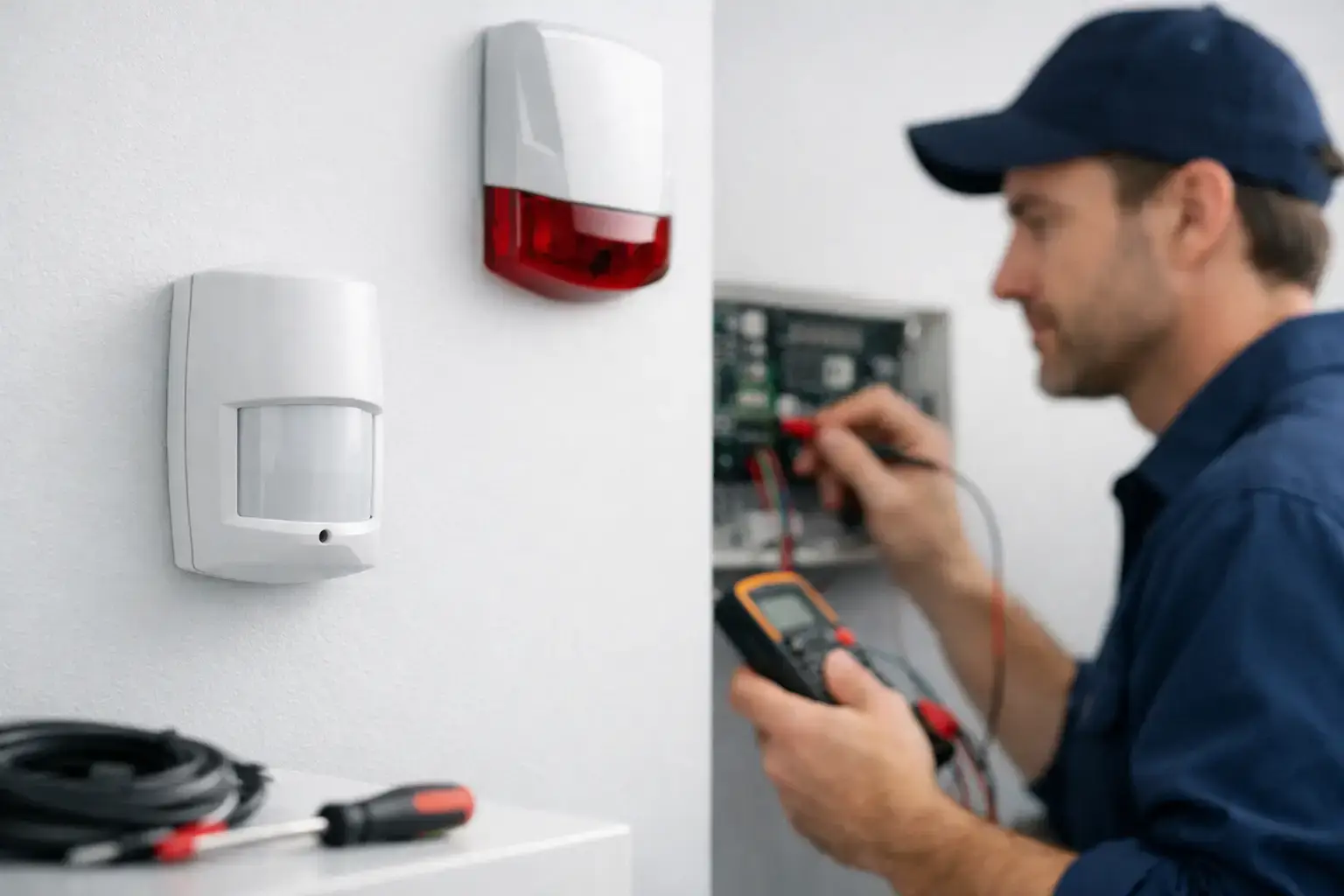
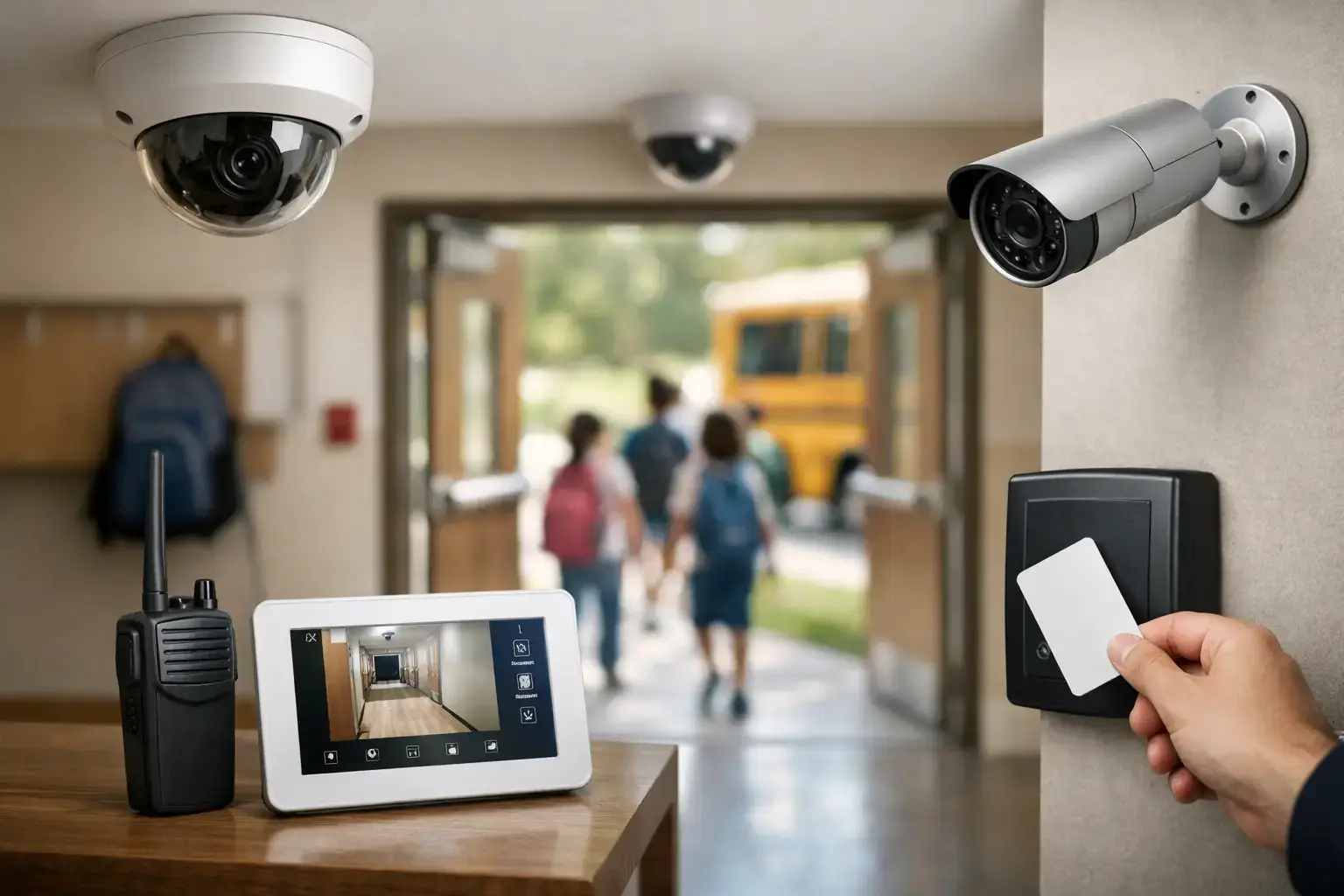
The final design combined several elements rather than relying on a single device. A monitored lockdown activation point was installed at reception and duplicated in the senior leadership office, with defined permissions for authorised staff. Once activated, the system sent a pre-programmed spoken and tone-based lockdown message through the school’s internal audio system, ensuring staff and pupils heard one consistent instruction at the same time.
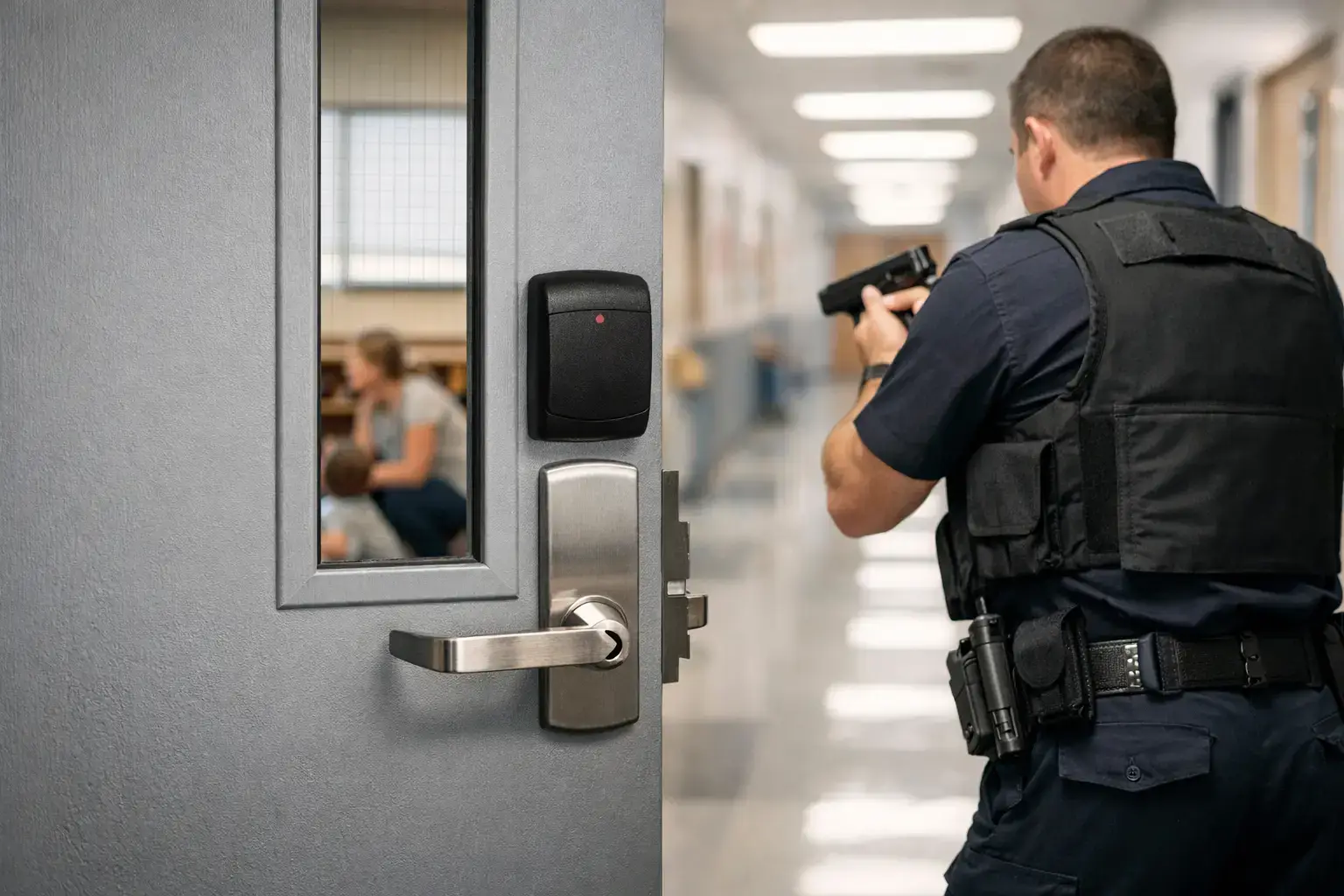
This was supported by visual alerts in key areas where noise levels were higher or hearing the message might be difficult, including the sports hall, dining area and corridors near practical classrooms. Access control was also integrated where possible, allowing selected doors to secure automatically while preserving safe escape routes and fire compliance.
That last point is crucial. Lockdown and fire safety must work together, not against each other. Any school considering these systems needs careful design input so that emergency egress remains protected. A lockdown system that creates confusion during a fire alarm is not a safety upgrade.
The school also chose to keep the operation simple. Staff were not expected to remember a sequence of technical steps. They needed one clear trigger, one clear message and one agreed classroom response. In security design, simplicity often improves reliability.
Why integration mattered more than adding devices
Before the upgrade, the school had separate pieces of security infrastructure: door access in some areas, intruder alarms after hours and basic public address capability. None of them formed a joined-up daytime emergency response. The value of the new arrangement came from integration.
Reception could initiate the procedure immediately. Senior staff had an alternative activation point. Locked doors, audible messaging and visible alerts supported each other. That reduced the chance of mixed responses across the campus.
It also reduced dependence on personal mobile phones. During fast-moving incidents, staff should not be expected to interpret fragmented messages from WhatsApp groups, missed calls or forwarded texts. A professionally designed system gives the school a single source of truth.
Implementation in a live school environment
Installation had to be planned around the school timetable, safeguarding controls and exam schedules. That is often overlooked when people compare commercial security with education projects. Schools are not empty buildings where engineers can work freely all day. There are restricted areas, vulnerable users, noise limits and narrow access windows.
The project was phased to avoid disruption. Core cabling and control work took place outside teaching hours where possible, while testing was coordinated with senior leaders and site management. Equally important, the school did not treat commissioning as the finish line. Staff training was built into handover, with separate sessions for reception, leadership and general teaching staff.
That training focused less on technical detail and more on response confidence. What does the alert sound like? Who initiates it? What should classrooms do first? When is a partial lockdown used? Good systems support good procedure, but they do not replace it.
Results from the case study
The first improvement was speed. The school moved from a manual, person-to-person communication method to near-instant site-wide instruction. In a lockdown situation, even a short delay matters, particularly during breaktimes or lesson changeovers.
The second improvement was consistency. Staff no longer had to decide whether a message was genuine, whether they had heard correctly, or whether another building had been informed. The same message reached the site at the same time, and the expected response was standardised.
The third improvement was leadership control. Senior staff could make decisions based on the scale of the incident rather than scrambling to manage communication itself. That distinction is significant. In an emergency, leadership attention should stay on risk assessment, external coordination and pupil welfare, not on whether someone remembered to phone the drama block.
There was also a less obvious benefit: reassurance. Parents may never see the control equipment, but schools that review and strengthen lockdown arrangements are better placed to demonstrate due diligence, governance and safeguarding maturity.
Lessons other schools can take from this
A lockdown policy is not the same as a lockdown system
Many schools already have written procedures, but paperwork on its own does not deliver an audible instruction across detached buildings or secure controlled doors in seconds. Policy and technology need to support one another.
One size does not fit every site
A primary school on one compact building may need a different setup from a split-site academy or college campus. Existing door hardware, public address systems and fire strategy all affect what is practical. The right answer depends on layout, occupancy and risk profile.
Training is as important as hardware
Even the best-designed system can underperform if staff are unsure when to trigger it or what happens next. Refresher drills, defined roles and simple procedures matter just as much as installation quality.
Compliance and reliability should lead the conversation
Schools should be cautious about improvised setups or consumer-grade products presented as quick fixes. Education settings need dependable, professionally configured systems that align with safeguarding duties, access requirements and long-term maintenance planning.
For many sites, this is why working with an experienced electronic security partner matters. A specialist such as 247 CCTV can assess the practical detail – access control, site layout, alert delivery, maintenance and integration – rather than treating lockdown as a standalone gadget.
School lockdown system case study: the wider point
The real value of a school lockdown system case study is not the technology itself. It is the reminder that emergency response works best when it is designed before it is needed. Schools are under pressure from every direction – safeguarding, estates management, budgets, inspections and parent expectations. Even so, lockdown planning cannot stay on the “we will sort that later” list.
The schools that tend to respond best are not necessarily the ones with the biggest budgets. They are the ones that ask the right questions early. Can we alert everyone immediately? Can we control movement sensibly? Have we trained staff properly? Will this still work on a wet Tuesday at lunchtime, not just during a planned drill?
If the answer is uncertain, that is usually the clearest sign that a review is due. In school security, confidence rarely comes from having more equipment. It comes from knowing the system will do what it is supposed to do when people need it most.