A warehouse with weak entry control rarely stays secure for long. Stock moves quickly, agency staff come and go, delivery drivers need access at odd hours, and multiple doors create opportunities for theft, trespass and simple human error. That is why warehouse access control systems have become a core part of site security, not an optional extra.
For warehouse operators, the challenge is not just keeping the wrong people out. It is making sure the right people can get into the right areas, at the right times, without slowing down goods in, picking, dispatch or night operations. When access is poorly managed, security gaps appear around loading bays, staff entrances, roller shutters, offices, cage stores and plant rooms. Those gaps can lead to stock loss, health and safety issues, disputes over accountability, and insurer concerns after an incident.
What warehouse access control systems actually do
At a practical level, warehouse access control systems replace keys and informal entry arrangements with controlled, traceable permissions. Instead of relying on who has a key or whether a door has been left on the latch, a site can decide exactly who may enter each zone and when.
That might mean warehouse operatives can enter the main floor and welfare areas during scheduled shifts, while supervisors can access admin offices, IT rooms or high-value stock cages. It may also mean external contractors are allowed through a single controlled door for a limited time only, rather than moving freely through the building.
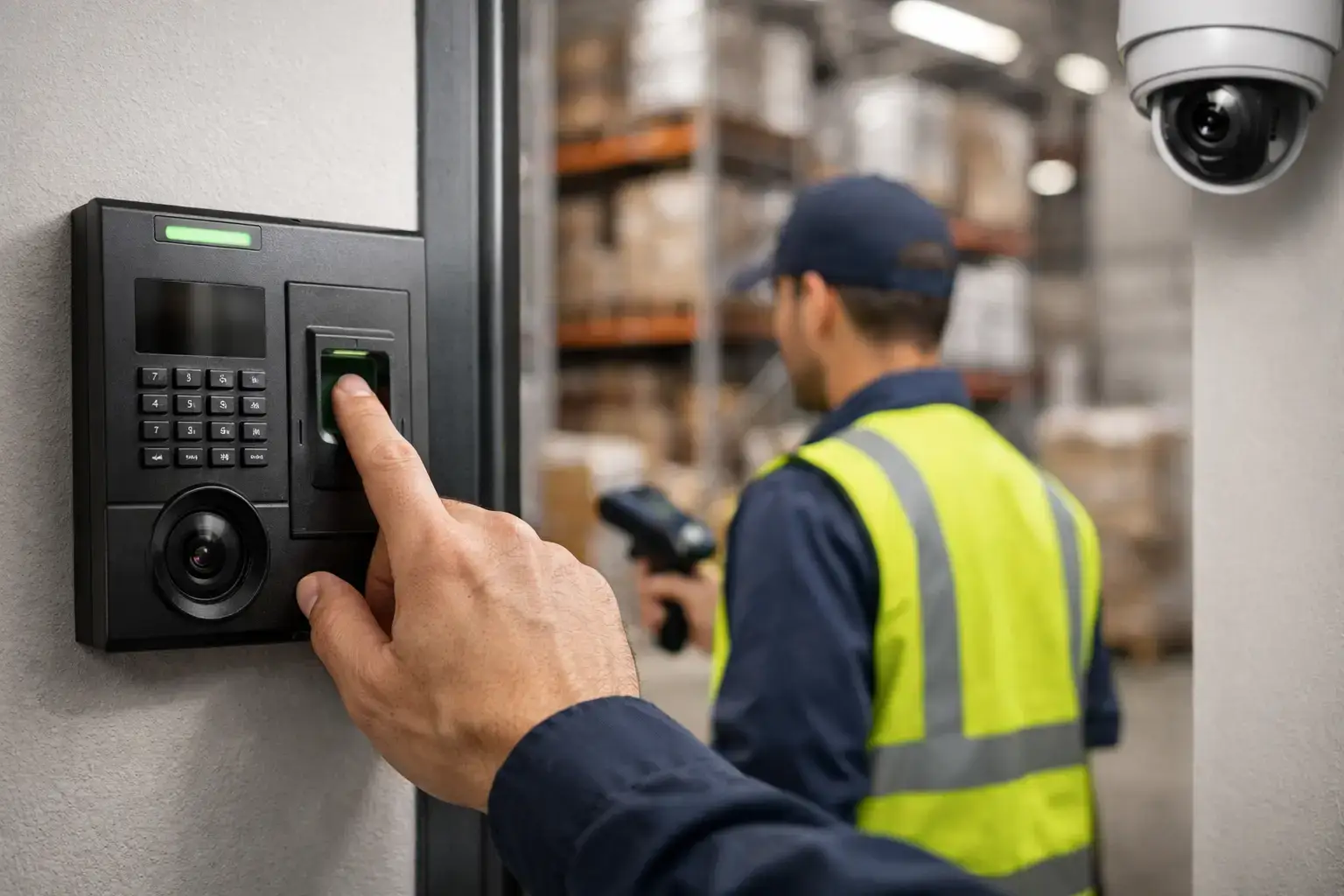
Modern systems often use fobs, cards, PINs, mobile credentials, intercoms or biometric readers, depending on the risk profile and how the building operates. The best setup is rarely the one with the most features. It is the one that matches how the warehouse actually works day to day.
Why warehouses need a different approach to access control
Warehouses are unlike standard offices. They have shift changes, large perimeter footprints, vehicle movement, temporary workers, and busy periods when security can be overlooked in favour of speed. A single warehouse might include pedestrian entrances, fire exits, shutter doors, goods-in doors, management offices and restricted storage rooms, all with different levels of risk.
That is why off-the-shelf systems can be a poor fit. A warehouse needs access control that takes account of traffic flow, emergency escape requirements, environmental conditions and the reality of staff turnover. Readers and locks in a clean office lobby may perform very differently on a dusty industrial unit with frequent opening cycles and harsh use.
There is also the issue of accountability. In a busy logistics environment, it matters whether you can verify who entered a stock room, who opened a gate at 4am, or whether a side door was forced or simply left unsecured. Access data can help resolve incidents quickly and reduce uncertainty for site managers.
The areas that usually need the most control
Not every door in a warehouse needs the same level of protection. In many cases, the greatest risks are concentrated in a few specific areas.
Loading bays are a common weak point because they combine external access, vehicle movement and operational pressure. Staff entrances are another, especially on sites with early starts, late finishes or agency workers. Offices inside the warehouse often contain sensitive records, keys or IT equipment, while high-value stock areas need tighter control than general storage. Plant rooms, server cupboards and hazardous goods zones may also require restricted access for safety as much as security.
A proper site survey helps distinguish between doors that need full electronic control, doors that need monitoring only, and doors where a mechanical solution may still be suitable. Overspecifying can add cost without improving protection. Underspecifying leaves the familiar problem of a security system that looks adequate on paper but fails in daily use.
Choosing the right credentials and door hardware
The choice between cards, fobs, PINs, mobile access or biometrics depends on the site, the users and the level of control required. Fobs and cards remain popular because they are straightforward, quick to issue and easy for staff to use. PIN entry can work well in lower-risk areas, but codes can be shared. Mobile credentials reduce the need for physical tokens, though they may not suit every workforce or environment.
Biometric readers can add another layer of certainty, particularly where stock is high value or access must be tightly restricted. Even then, they are not automatically the right answer. Gloves, dirt, weather exposure and throughput demands can all affect performance. In some warehouses, a combined method such as card plus PIN makes more sense than going fully biometric.
Hardware matters just as much as the reader itself. Magnetic locks, electric strikes, monitored door contacts, emergency break-glass units and request-to-exit devices all need to be selected correctly for the door type and compliance requirements. Warehouse doors can be heavy-use, metal-clad, externally exposed or tied into fire strategy, so installation quality is critical.
Integration makes the system more useful
Access control works best when it is not isolated from the rest of the security setup. In many warehouses, integration with CCTV is what turns a simple entry system into a stronger management tool. If a door is forced, held open or accessed out of hours, linked cameras can provide instant visual verification.
This is particularly useful where there are disputes about deliveries, stock movements or unauthorised attendance. An audit trail showing a credential was used at a certain time is valuable. Matching that event to video footage is even better.
Intruder alarms also play an important role. Access control can be configured so that authorised users can enter and unset specific areas without affecting the whole site. That reduces user error and helps larger premises operate safely outside normal hours. For some businesses, linking access control with door entry at reception or gate control at the perimeter can create a more complete security strategy.
Compliance, fire safety and insurer expectations
Warehouse security decisions should never ignore compliance. Doors on escape routes, fire doors and final exits all need careful treatment. Access control must support safe evacuation and meet relevant regulations, not create obstacles in an emergency.
This is where professional design matters. A system has to balance restricted access with safe egress, appropriate fail-safe or fail-secure operation, and dependable behaviour during power loss or alarm activation. Getting this wrong creates operational and legal risks.
Insurers may also take an interest in how high-risk stock, controlled goods or restricted areas are secured. A professionally specified and installed system can support risk management and demonstrate that access is actively controlled rather than left to informal procedures.
What to expect from a professionally designed system
The strongest results come from a site-specific design rather than a catalogue approach. A proper assessment should look at how people enter the site, which areas need separation, what happens outside normal hours, and where losses or vulnerabilities have already appeared.
For some sites, that may mean a straightforward networked system covering two or three critical doors. For others, it may involve multiple user groups, time-based permissions, anti-passback rules, remote management and integration with monitored CCTV. The point is not complexity for its own sake. It is giving the business enough control to reduce risk without making everyday operations harder.
Long-term support is just as important as installation. Warehouses are hard-working environments. Doors get knocked, readers wear, staff lists change and access permissions need regular updating. A reliable maintenance arrangement helps keep the system effective months and years after commissioning.
For businesses in Essex, London and the South East, working with an experienced installer such as 247 CCTV can make the difference between a system that simply opens doors and one that genuinely improves site security, accountability and day-to-day control.
When is it time to upgrade warehouse access control systems?
Many warehouses continue with keys, standalone keypad locks or a mixture of old and new systems long after those arrangements have stopped being effective. If keys are unaccounted for, doors are regularly propped open, contractors move around unescorted, or managers cannot confirm who accessed a restricted area, the site is already showing signs that an upgrade is due.
Another common trigger is growth. A system that worked for a small unit with a stable team may not suit a larger operation with shift patterns, multiple departments and temporary staff. Changes in insurer requirements, stock value, theft history or opening hours can also justify a review.
The right answer is not always a full replacement. Sometimes an existing system can be extended, integrated or reconfigured. In other cases, patching together older equipment only delays a more sensible upgrade. It depends on the age of the hardware, the quality of the original installation and what the warehouse now needs to achieve.
A good warehouse should feel controlled without feeling obstructed. When access is properly managed, staff can work efficiently, managers have clearer oversight, and the site is better protected against both opportunistic intrusion and internal risk. If your building still relies on keys, guesswork or doors that are secure only when everyone remembers to shut them, it is worth taking a closer look at what better access control could prevent.