A break-in in a shared entrance or repeated anti-social behaviour in a block corridor often leads to the same question – is CCTV allowed in communal areas? The short answer is yes, it can be, but only if it is installed for a clear reason, operated fairly, and managed in line with UK data protection and privacy rules.
That matters because communal areas sit in a grey zone for many property owners and managers. They are not fully private in the way a flat or office suite is, but they are not public streets either. Hallways, shared gardens, bin stores, reception areas, car parks and access routes are used by multiple people, and recording them creates legal responsibilities for whoever controls the system.
Is CCTV allowed in communal areas in the UK?
In the UK, CCTV in communal areas is generally allowed where there is a legitimate reason for it. That reason might be crime prevention, staff safety, protecting residents, monitoring unauthorised access, or investigating repeated incidents such as vandalism, fly-tipping or theft from shared spaces.
What makes the difference is not simply where the cameras are fitted, but whether the use is proportionate. A camera covering the main entrance to a block of flats after a string of access-related incidents is easier to justify than a camera pointed constantly at residents’ doors with no clear need. In the same way, monitoring a commercial building’s shared reception for security is often reasonable, while recording private rest areas without strong justification is much harder to defend.
For most managed residential and commercial sites, the key legal framework is UK data protection law. If the CCTV system records identifiable people, the organisation or person responsible for it is likely acting as a data controller. That brings duties around transparency, lawful basis, data minimisation, security and retention.
Why communal areas need more care than private spaces
Communal spaces create a balance between security and privacy. Residents, tenants, staff, visitors and contractors all expect shared areas to be safe, but they also expect not to be monitored excessively.
This is where many poorly planned systems fall short. The issue is rarely the existence of CCTV itself. It is often the scope of the recording. If cameras capture more than they need to, record audio unnecessarily, or are installed without proper signage and policy, the risk shifts from improving security to creating complaints.
A professional survey helps avoid that. Camera positions, fields of view, image quality, retention settings and user access should all be matched to the actual risk. In practice, that means covering entry points, vulnerable routes and incident hotspots rather than taking a blanket approach.
Who can install CCTV in communal areas?
The party with control over the communal area is usually the one entitled to install CCTV, provided there is a lawful and justifiable purpose. That could be a freeholder, managing agent, residents’ management company, landlord, commercial building operator or employer.
Leaseholders and tenants need to be more careful. A private individual cannot usually decide on their own to monitor a shared hallway or stairwell just because they feel safer doing so. If the camera records beyond the boundary of their own demise and into common parts used by others, legal and management issues arise quickly. Permission from the building owner or manager is often required, and even then the installation must be justified and compliant.
For businesses, the same principle applies. If you operate offices, warehouses, retail units or mixed-use premises with shared circulation areas, CCTV may be appropriate, but the responsibility sits with the organisation controlling the monitoring.
The main rules you need to follow
The legal position depends on the setup, but several core principles apply in most cases.
You need a clear purpose. Security, safety and crime prevention are common and valid reasons, but they should be specific. Saying a camera is installed “just in case” is weak if challenged.
You need a lawful basis under data protection law. For most organisations this is likely to be legitimate interests, provided the security need outweighs the privacy impact.
You need to be transparent. People should know they are being recorded. Clear signage at entrances and in monitored areas is standard good practice, and it should identify who is responsible for the system.
You should only capture what is necessary. Cameras should avoid private windows, internal residential areas, and neighbouring property where possible. Audio recording needs particular caution because it is much more intrusive.
You must keep footage secure. Access should be restricted, downloads controlled, and the system protected against unauthorised viewing or tampering.
You should not keep recordings longer than needed. Retention periods vary depending on the site and risk profile, but they should be defined and justifiable.
Residential blocks and estates
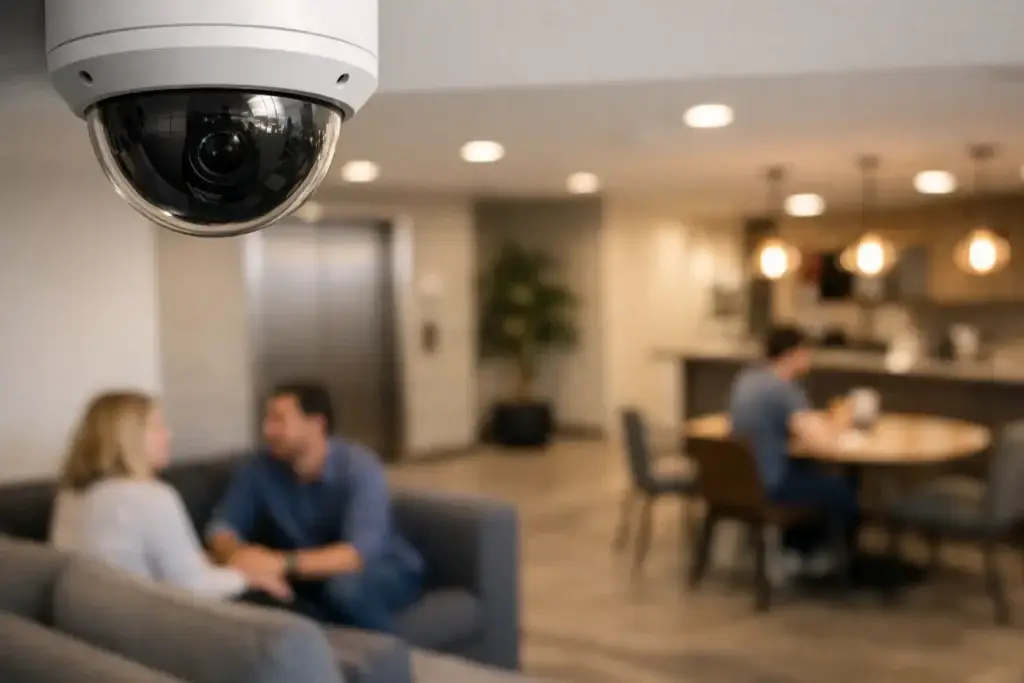
In residential settings, communal CCTV is often used in entrances, lobby areas, car parks, cycle stores, bin areas and external approaches. These are all common points for tailgating, theft, nuisance behaviour and criminal damage.
The challenge in blocks of flats is that the same camera that reassures one resident may feel intrusive to another. This is why consultation, policy and careful placement matter. A system designed around key access routes and incident points will usually be easier to justify than one that tracks day-to-day resident movement in detail.
Where there is a managing agent or residents’ management company, it is sensible to document the reason for the system, complete a privacy impact assessment where appropriate, and make sure residents understand what is being recorded and why. That does not mean everyone has to agree, but it does mean the decision should be evidenced rather than improvised.
Commercial premises and shared business spaces
For commercial sites, CCTV in communal areas is often even more straightforward to justify. Shared receptions, loading bays, service corridors, stairwells, staff entrances and car parks are all areas where access control and incident investigation are legitimate operational concerns.
That said, the same caution applies. Staff welfare and visitor privacy still matter. Cameras should support site security, not replace proper management. If there are sensitive areas such as break rooms, prayer rooms or welfare spaces, surveillance needs especially strong justification and often should be avoided.
On larger sites, communal CCTV often works best when integrated with access control, intruder alarms and monitored response procedures. That creates a more dependable security strategy than relying on cameras alone.
Common mistakes that cause problems
The biggest mistake is over-coverage. If a camera is set too wide, it may record front doors, private balconies, neighbouring property or parts of the public highway with no real need.
The second is poor communication. Residents, tenants and staff are far less likely to object when the purpose is clear, signage is visible, and the system is obviously there to address a real risk.
The third is treating CCTV as a DIY legal decision rather than a security project. A poorly positioned camera, weak image quality, no audit trail and no usage policy can leave you with both compliance risk and unusable evidence.
When CCTV in communal areas may not be justified
There are cases where the answer is effectively no, or at least not in the form proposed. If there has been no real security concern, if the camera placement is excessively intrusive, or if less invasive measures would reasonably solve the issue, a communal CCTV installation may be hard to justify.
For example, if the real problem is uncontrolled access, improving door entry and access control may be the better first step. If lighting is poor in a shared car park, upgrading illumination may reduce incidents without expanding surveillance. Good security design is not about putting a camera everywhere. It is about selecting the right controls for the risk.
Getting it right from the start
If you are considering CCTV for a shared residential or commercial space, the safest approach is to start with a proper site survey and a clear operational need. Look at what is actually happening on site, where the vulnerabilities are, who needs access to footage, and how privacy can be protected.
Professionally specified systems are easier to defend because they are designed around necessity, coverage, image standards and compliance rather than guesswork. That is especially important for managed blocks, public-facing businesses and multi-occupancy properties where complaints, subject access requests or insurer requirements may all come into play.
For property owners and managers across Essex, London and the South East, the practical answer is this: communal area CCTV is often permitted, but it should never be casual. A compliant system protects people, supports investigations and reduces risk without crossing the line into unnecessary monitoring. If you plan it carefully, shared-space CCTV can do exactly what it should – improve safety while respecting the people who use the building every day.