A fire alarm decision usually gets pushed back until a refurbishment, fit-out or compliance review forces the issue. That is often the moment people start comparing conventional vs addressable fire alarms and realise the choice affects far more than the control panel on the wall. It affects how quickly a fire can be located, how faults are traced, how easily the system can expand, and how much disruption ongoing maintenance creates.
For a small building with a simple layout, a conventional system can still be the right answer. For larger or more complex premises, an addressable system often gives better control and better information. The best option depends on the building, the fire strategy, the budget and how the site is used day to day.
What is the difference between conventional and addressable fire alarms?
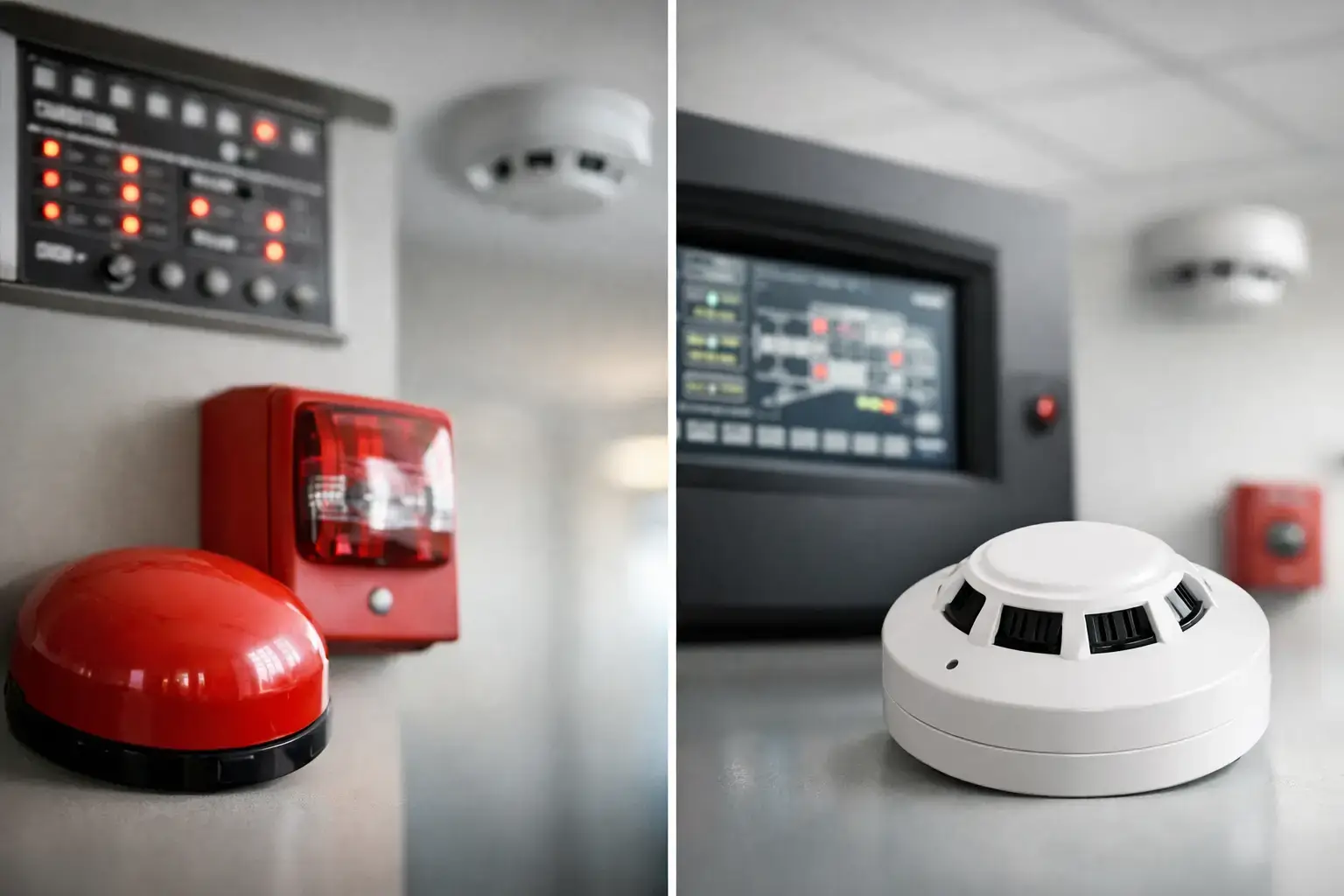
The simplest way to understand it is this: a conventional fire alarm identifies the area of activation, while an addressable fire alarm identifies the exact device.
In a conventional system, detectors and call points are grouped into zones. If there is an activation, the panel shows which zone has gone into alarm, such as Ground Floor Offices or First Floor Corridor. Someone then needs to investigate that area to find the triggered detector or call point.
In an addressable system, each device has its own electronic address. When an alarm occurs, the panel can identify the individual detector, sounder or call point, such as Smoke Detector – Reception Lobby. That extra detail can save valuable time, especially on larger sites or where staff need clear information quickly.
How conventional fire alarms work
Conventional systems are built around separate wiring circuits, usually divided by zones. Each zone covers a section of the building, and devices in that section report back collectively rather than individually.
This approach is straightforward and reliable when the property is small and the layout is uncomplicated. In a modest office, small retail unit, village hall or standard house in multiple occupation, a conventional panel may provide suitable coverage without unnecessary complexity.
There are practical limits, though. If a detector on a conventional zone activates, the panel tells you the zone, not the exact head. If a fault develops, tracing it can take longer because engineers are working through that circuit to locate the issue. On a simple site that may be manageable. On a busy commercial premises, it can mean more downtime and more disruption.
How addressable fire alarms work
Addressable systems use loops rather than simple zonal circuits, with each device programmed and identified individually. The panel communicates with every detector, manual call point, input and output module, and often sounders as well.
That allows much more precise monitoring. If there is an alarm, the system pinpoints the device. If there is a fault, the panel can show where it is. If a detector becomes contaminated or starts behaving outside expected limits, the panel may provide early warning before it causes nuisance alarms or loses effectiveness.
This level of control makes addressable systems well suited to larger offices, schools, hotels, warehouses, healthcare environments and multi-area commercial buildings. They are also useful on sites that may expand later, because adding and programming devices is generally more flexible than redesigning multiple conventional zones.
Conventional vs addressable fire alarms on cost
Up-front cost is often the first comparison buyers make, and fairly so. Conventional systems are usually cheaper to install at the lower end of the market. The equipment can be less expensive, and on smaller sites the design and commissioning process may be simpler.
Addressable systems typically cost more initially. Panels, devices and programming are more advanced, and the specification is usually higher. If a client compares only the installation quote, conventional can look like the obvious saving.
That said, cheapest at installation does not always mean cheapest over the life of the system. On a site where faults need to be located quickly, where staff time is expensive, or where the building may change use, the extra intelligence of an addressable system can reduce maintenance time and future alteration costs. The larger and more operationally sensitive the site, the stronger that argument becomes.
Finding alarms and faults quickly
This is where the difference becomes very practical.
With a conventional system, an alarm on Zone 3 tells the responsible person where to start looking. If Zone 3 covers six rooms and a corridor, someone still has to check each device until the source is identified. If the building is noisy, multi-storey or occupied by the public, those minutes matter.
With an addressable system, the panel can identify the exact detector or call point in alarm. That improves response speed and can help emergency services and site teams understand the situation sooner. The same applies to faults. Instead of investigating a whole zone, engineers can usually go directly to the affected device or section.
For many facilities managers, this is one of the main reasons to choose addressable technology. It gives clearer information when pressure is highest.
Which buildings suit each system?
Conventional systems generally suit smaller, simpler properties with limited fire alarm devices and a clear layout. If the building is easy to search, the occupancy is low, and there is little need for future expansion, conventional can be a sound and cost-effective option.
Addressable systems are usually better for larger or more complex sites. That includes buildings with multiple compartments, several floors, plant areas, voids, high occupancy, sleeping risk or a requirement for phased evacuation and integration with other life safety systems.
A school, care environment, hotel or industrial premises will often benefit from the additional detail an addressable system provides. The same goes for commercial properties where downtime, false alarms or slow fault finding have operational consequences.
Expansion, changes and long-term flexibility
Buildings rarely stay exactly the same. Offices are partitioned, warehouses are reconfigured, units are extended and landlords alter layouts between tenancies. A fire alarm system needs to cope with that.
Conventional systems can be extended, but the process is usually less flexible. New areas may require additional zones, extra cabling and a careful look at panel capacity. Once the building becomes more complex, a conventional setup can start to feel restrictive.
Addressable systems are generally easier to adapt. Devices can be added, renamed and reprogrammed in a more controlled way, provided the design remains compliant and panel capacity allows. That flexibility is valuable for growing businesses, managed premises and sites with changing occupancy patterns.
False alarms and system management
No fire alarm system should be chosen on marketing claims alone, but addressable systems do offer more tools for managing performance. Depending on the specification, they can support pre-alarm settings, drift compensation, device sensitivity adjustments and more detailed event history.
That does not mean a conventional system is inherently poor or unreliable. A correctly designed and maintained conventional system can perform very well. But if a site has recurring false alarm issues, mixed-risk areas or a need for tighter control over cause-and-effect functions, addressable technology usually provides more options.
Compliance is about design, not just technology
One point is worth stressing. Addressable does not automatically mean compliant, and conventional does not automatically mean inadequate. Compliance depends on proper survey, design, installation, commissioning and maintenance in line with the relevant standards and the building’s fire risk assessment.
A poorly specified addressable system can still be the wrong solution. Equally, a well-designed conventional system may be entirely suitable for the premises. The question is not which technology sounds more advanced. The question is which system supports the fire strategy and the way the building is actually used.
That is why site assessment matters. Detector choice, zoning logic, audibility, call point positions, interfaces, monitoring requirements and ongoing service arrangements all play a part in whether the finished system performs properly when needed.
So, which should you choose?
If you are protecting a smaller, straightforward property and need a dependable, cost-conscious solution, a conventional system may be the right fit. If you need precise device identification, easier fault finding, better scalability and stronger management features, an addressable system is often the better long-term investment.
For many commercial clients, the decision comes down to risk, complexity and future plans. A small single-storey unit is very different from a multi-tenant office, a school, a care setting or a warehouse with several operational zones. The more complicated the building, the stronger the case for addressable.
An experienced installer should be able to explain the trade-offs clearly, without pushing a higher specification where it is not needed. That is the standard 247 CCTV works to across Essex, London and the South East – practical advice, compliant design and systems that suit the site rather than a generic package.
If you are weighing up options for a new installation or an upgrade, the right answer is usually the one that gives you confidence on the day the panel sounds, not just the one that looks cheaper on the first quote.