

Choosing the right data storage solution for your CCTV system can feel overwhelming, especially when you’re balancing security needs, budget constraints, and compliance requirements. A single 4K camera can generate over 6 terabytes of footage annually, and improper storage can risk both your security posture and GDPR compliance. This guide walks you through local, cloud, and hybrid storage options, explains how modern compression technologies like H.265 reduce storage demands, and provides practical advice for businesses in Essex and London to make informed decisions that protect both property and data.
Key takeaways
| Point | Details |
|---|---|
| H.265 compression advantage | H.265 reduces storage needs up to 50% compared to H.264 whilst maintaining video quality. |
| Storage options available | Local, cloud, and hybrid storage each offer distinct benefits for accessibility, cost control, and compliance. |
| GDPR compliance essential | Data protection regulations mandate secure storage, clear retention policies, and controlled access for CCTV footage. |
| Selection factors | Camera resolution, available bandwidth, budget, and business priorities determine the optimal storage approach. |
| Future proofing matters | Scalable storage solutions accommodate growing camera networks and evolving compliance requirements. |
Understanding CCTV video data requirements
High-definition CCTV cameras create substantial video files that demand efficient storage planning. A single 1080p camera recording continuously can generate approximately 2 terabytes annually, whilst 4K cameras can produce triple that volume. The sheer scale of data means businesses must carefully consider both immediate storage capacity and long-term retention requirements.

Video compression standards directly impact how much storage your CCTV system requires. H.265 compression reduces bandwidth and storage up to 50% compared to H.264 whilst maintaining identical video quality. This efficiency translates to storing 30 to 60% more footage per terabyte, a significant advantage for businesses managing multiple cameras across sites in Essex and London.
Modern CCTV installations increasingly favour H.265 encoding, particularly when deploying high-resolution cameras or working with limited network bandwidth. However, older video management systems may require H.264 due to compatibility constraints. Understanding your existing infrastructure helps you choose compression standards that balance storage efficiency with system compatibility.
Bandwidth availability influences both compression choices and storage architecture. Locations with restricted internet connectivity may struggle with cloud-based storage for high-resolution feeds, making local storage more practical. Conversely, sites with robust broadband can leverage cloud solutions for flexible, offsite backup without overwhelming network resources.
Pro Tip: Calculate your storage needs by multiplying camera count, resolution, retention period, and compression ratio. Online CCTV storage calculators provide quick estimates, but factor in motion detection settings that reduce recording time and storage consumption.
Camera resolution directly affects storage planning:
- 1080p cameras typically require 1 to 2 terabytes per camera annually with H.264
- 4K cameras demand 4 to 6 terabytes per camera annually with H.264
- H.265 encoding reduces these figures by approximately 40 to 50%
- Motion-activated recording can cut storage needs by 60 to 80% compared to continuous recording
For businesses exploring CCTV implementation, our CCTV setup guide for Essex and London provides detailed planning frameworks including storage calculations tailored to local business contexts.
Exploring different data storage options for CCTV systems
Local storage solutions place video data on physical devices at your premises, typically using network video recorders or dedicated servers. This approach offers immediate access to footage without internet dependency, faster retrieval speeds, and complete control over your data. Businesses prioritising data sovereignty and rapid incident response often prefer local storage for critical camera feeds.
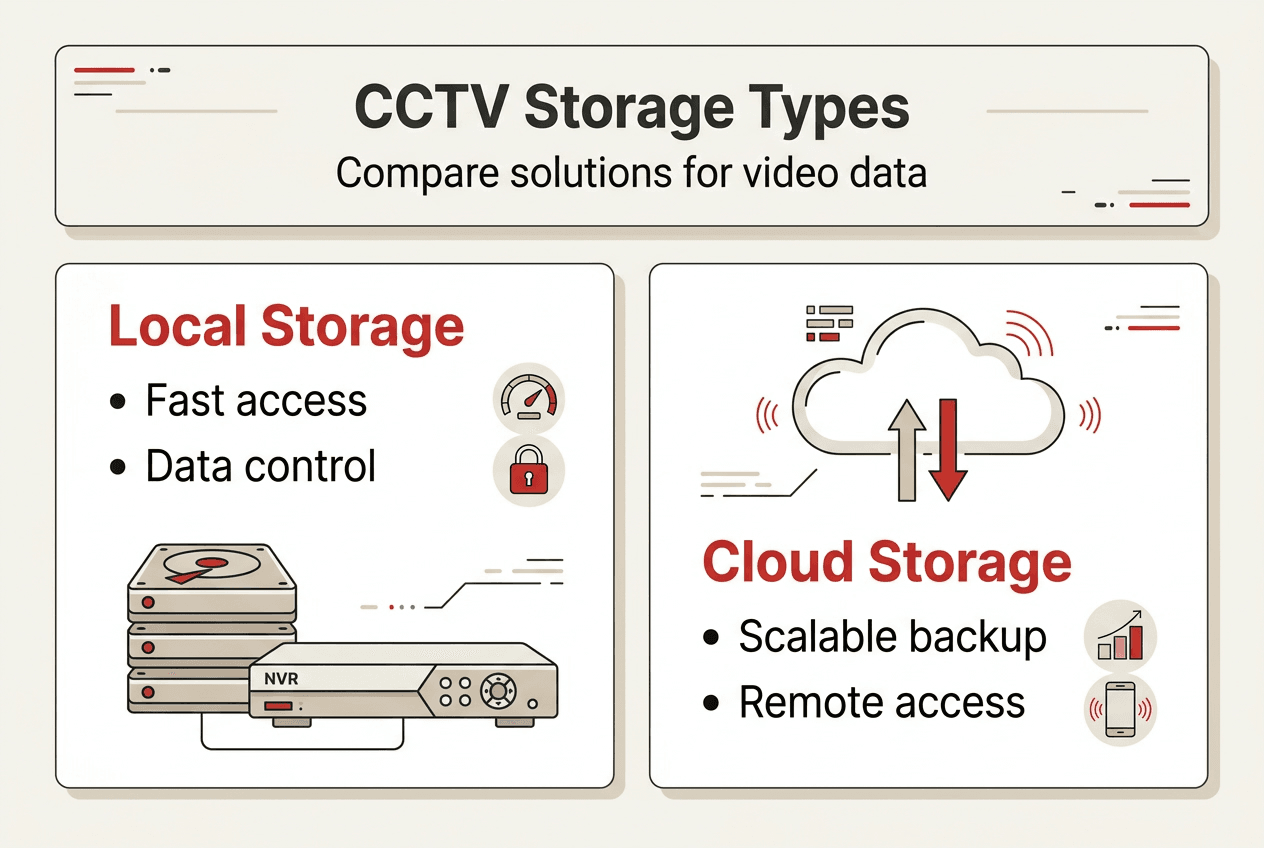
Cloud storage shifts video data to remote servers managed by service providers, enabling offsite backup and scalable capacity without hardware investment. You pay ongoing subscription fees based on storage volume and retention periods. Cloud solutions excel for businesses with multiple sites, remote management needs, or limited IT infrastructure, though they require reliable internet connectivity and introduce recurring costs.
Hybrid storage combines local and cloud approaches, storing recent footage locally for quick access whilst archiving older recordings to the cloud for long-term retention. This strategy balances the benefits of both methods, providing fast local retrieval for active investigations and secure offsite backup for compliance and disaster recovery. Many Essex and London businesses adopt hybrid models to optimise costs whilst maintaining comprehensive coverage.
| Storage Type | Primary Advantages | Key Considerations |
|---|---|---|
| Local | Fast access, data control, no recurring fees | Higher upfront costs, physical security risks, limited scalability |
| Cloud | Offsite backup, scalable capacity, remote access | Ongoing subscription fees, internet dependency, potential latency |
| Hybrid | Balanced approach, optimised costs, redundancy | Requires coordination, moderate complexity, dual infrastructure |
Compliance with data protection regulations including GDPR is mandatory regardless of storage method. You must implement appropriate security measures, define clear retention periods, and restrict access to authorised personnel. Cloud providers should demonstrate UK GDPR compliance, including data processing agreements and transparent security practices.
Choosing storage depends on several business factors:
- Business size and camera count influence infrastructure requirements
- Budget constraints affect preference for capital expenditure versus operational expenses
- IT capabilities determine whether managed cloud services or self-maintained local systems suit better
- Regulatory requirements may mandate specific data residency or security controls
- Growth plans should inform scalability needs and future expansion capacity
Pro Tip: For businesses in Essex and London, consider local storage for immediate access to footage, especially for high-priority areas. Use cloud storage for archiving and offsite backup. Our CCTV data protection guidance explains compliance requirements specific to UK businesses in 2026.
Choosing the right storage technology for your CCTV system
Modern video management system platforms increasingly support H.265 encoding, enabling substantial bandwidth and storage savings without compromising video quality. When selecting storage technology, verify that your VMS, cameras, and storage infrastructure all support your chosen compression standard. Compatibility across the entire system ensures you realise the full efficiency benefits of advanced encoding.
High-resolution cameras deploying 4K or 8K sensors require careful storage planning due to their substantial data output. H.265 is the better choice when using modern VMS platforms, dealing with limited bandwidth, or installing 4K or 8K cameras. The compression efficiency becomes critical at higher resolutions where file sizes would otherwise become unmanageable.
Budget constraints significantly influence storage decisions between local, cloud, and hybrid approaches. Local storage demands higher upfront capital investment in hardware but eliminates ongoing subscription fees. Cloud storage spreads costs over time through monthly or annual fees, making it accessible for businesses preferring operational expenditure models. Hybrid solutions balance both, optimising total cost of ownership over the system lifecycle.
Ensure your chosen storage solution meets current and anticipated data protection regulations. UK GDPR requirements mandate secure data handling, defined retention periods, and controlled access regardless of storage location. Cloud providers must demonstrate compliance through certifications, whilst local storage requires you to implement equivalent security measures internally.
Future proofing considerations:
- Select scalable storage that accommodates camera network expansion
- Choose flexible architectures supporting both local and cloud integration
- Verify compatibility with emerging compression standards beyond H.265
- Plan for increased resolution demands as camera technology advances
- Consider storage solutions offering easy migration paths between deployment models
Pro Tip: Calculate total cost of ownership over five years including hardware, subscriptions, maintenance, and replacement costs. This longer-term perspective often reveals that hybrid solutions offer better value than pure local or cloud approaches for growing businesses.
Working with experienced installers ensures your storage technology aligns with camera specifications, network infrastructure, and business requirements. Our CCTV installation services in Essex and London include comprehensive storage planning tailored to your specific operational context and compliance obligations.
Best practices for managing CCTV data storage and compliance in Essex and London businesses
Regular review of data retention periods ensures you store footage only as long as necessary for legitimate purposes. GDPR principles require data minimisation, meaning you should delete recordings once they no longer serve their intended security or legal purpose. Most businesses retain footage for 30 to 90 days unless specific incidents require longer preservation.
Implementing strong access controls protects stored footage from unauthorised viewing or tampering. Limit access to designated security personnel, maintain detailed access logs, and use role-based permissions to enforce the principle of least privilege. Encryption for data at rest and in transit provides additional protection against breaches, particularly for cloud-stored footage.
Maintaining clear documentation of storage locations, retention policies, and access procedures demonstrates compliance during audits and regulatory reviews. Your documentation should specify where footage is stored, who can access it, how long it’s retained, and the security measures protecting it. This transparency builds trust with employees, customers, and regulators whilst simplifying compliance with GDPR requirements.
Staff training on data protection responsibilities ensures everyone handling CCTV footage understands their obligations. Training should cover:
- Legal basis for CCTV operation and data collection
- Proper procedures for accessing and reviewing footage
- Confidentiality requirements and information security practices
- Response protocols for data subject access requests
- Incident reporting procedures for suspected breaches or unauthorised access
Secure backup and recovery mechanisms protect against data loss from hardware failures, cyberattacks, or physical disasters. Test your backup systems regularly to verify you can successfully restore footage when needed. For businesses using local storage, offsite backups provide essential redundancy, whilst cloud storage inherently offers geographic distribution.
Compliance checklist for Essex and London businesses:
- Conduct annual reviews of retention periods and delete outdated footage
- Maintain current access control lists with quarterly audits
- Document all storage locations and security measures
- Provide regular staff training on GDPR and data protection
- Test backup and recovery procedures at least twice annually
- Review and update privacy notices reflecting current storage practices
- Monitor for security updates and patches for storage systems
Our guides on CCTV regulations in Essex and data security for CCTV in the UK provide detailed frameworks for maintaining ongoing compliance whilst optimising your security infrastructure.
Explore professional CCTV solutions with 247 CCTV Security
Navigating CCTV data storage decisions becomes simpler with expert guidance tailored to your specific business context. Whether you’re establishing a new surveillance system or upgrading existing infrastructure, professional support ensures you select storage solutions that balance security effectiveness, regulatory compliance, and operational efficiency.

247 CCTV offers comprehensive installation services across Essex and London, including detailed storage planning that accounts for your camera specifications, retention requirements, and budget parameters. Our team designs solutions incorporating the optimal mix of local, cloud, and hybrid storage based on your unique operational needs.
For businesses seeking flexible financial arrangements, our CCTV leasing options in Essex provide access to advanced surveillance technology without substantial capital investment. Leasing agreements can include managed storage services, ensuring your data infrastructure scales alongside your security requirements whilst maintaining compliance.
Advanced analytic CCTV surveillance solutions reduce false alarms and improve monitoring efficiency through intelligent event detection. These systems optimise storage utilisation by recording only relevant activity, significantly reducing data volumes whilst enhancing security outcomes. Professional configuration ensures analytics integrate seamlessly with your chosen storage architecture.
FAQ
What are the main CCTV data storage types and their advantages?
Local storage provides fast, direct access to footage with complete data control and no recurring subscription fees, ideal for businesses prioritising immediate retrieval and data sovereignty. Cloud storage offers scalable offsite backup with remote access capabilities, suited to multi-site operations or businesses with limited IT infrastructure. Hybrid approaches combine both methods, balancing quick local access with secure cloud archiving for comprehensive coverage and disaster recovery.
How does H.265 video compression improve CCTV data storage efficiency?
H.265 compression reduces storage requirements by up to 50% compared to H.264 whilst maintaining identical video quality, enabling businesses to store significantly more footage per terabyte. This efficiency proves particularly valuable for high-resolution 4K and 8K cameras that generate substantial data volumes. Modern video management systems increasingly support H.265, making it the preferred choice for new installations seeking to optimise bandwidth and storage costs.
What should businesses in Essex and London consider for CCTV data compliance?
Businesses must adhere to GDPR requirements governing data access, retention periods, and secure storage of CCTV footage. Implement clear policies defining who can access footage, how long recordings are retained, and what security measures protect stored data. Regular audits, staff training, and documented procedures demonstrate compliance whilst minimising risks of regulatory penalties or data breaches.
How much storage capacity does a typical business CCTV system require?
Storage requirements vary based on camera count, resolution, compression standard, and retention period. A business with ten 1080p cameras using H.265 compression and 30-day retention typically needs 6 to 8 terabytes of storage capacity. High-resolution 4K cameras or longer retention periods substantially increase these requirements. Motion-activated recording rather than continuous capture can reduce storage needs by 60% or more, making capacity planning highly dependent on specific operational parameters.
Can I combine local and cloud storage for my CCTV system?
Hybrid storage architectures combining local and cloud solutions offer excellent flexibility and redundancy for many businesses. You can store recent footage locally for fast access during active investigations whilst automatically archiving older recordings to the cloud for long-term retention and offsite backup. This approach optimises costs by using expensive local storage for short-term needs and more economical cloud storage for extended archives, whilst providing comprehensive disaster recovery capabilities.
Recommended
- Analogue vs Digital CCTV: Choosing the Right Fit – 247 CCTV Security Ltd
- Data Security in CCTV – What UK Facilities Managers Must Know – 247 CCTV Security Ltd
- CCTV data protection for UK businesses in 2026 – 247 CCTV Security Ltd
- CCTV Recording Duration – Ensuring Compliance and Security – 247 CCTV Security Ltd