

Many business owners mistakenly believe CCTV security exemptions mean they can ignore data protection laws; the truth is quite the opposite. UK GDPR applies to all CCTV systems capturing identifiable individuals, regardless of whether you’re protecting property or monitoring staff. With the Data (Use and Access) Act 2025 now in force, businesses in Essex and London face updated compliance requirements, clearer subject access request procedures, and stricter safeguards around AI surveillance. This guide explains how to navigate these regulations, avoid ICO penalties, and implement lawful CCTV systems that balance security with privacy.
Key takeaways
| Point | Details |
|---|---|
| CCTV footage is personal data | UK GDPR applies to all surveillance capturing identifiable individuals, requiring lawful processing bases |
| Transparency is mandatory | Clear, visible signage at monitored areas must inform individuals about CCTV use and data controller contact details |
| 2025 Act updates requirements | New legislation eases some restrictions whilst introducing mandatory safeguards for AI-based surveillance systems |
| Subject access requests have strict deadlines | You must respond within one calendar month, with searches proportionate and reasonable under 2026 rules |
| Standard retention is 30 days | Longer storage requires justification and documented policies balancing security needs with data minimisation |
Introduction to CCTV data protection in the UK
Under UK GDPR, CCTV footage capturing identifiable individuals is personal data subject to data protection principles. This means every business using surveillance cameras must comply with regulations designed to protect individual privacy whilst allowing legitimate security operations. The legal framework governing CCTV has three main components: UK GDPR, the Data Protection Act 2018, and the newly implemented Data (Use and Access) Act 2025.
These laws work together to establish clear obligations for anyone processing personal data through video surveillance. For Essex and London businesses, compliance isn’t optional. ICO enforcement actions can result in substantial fines, reputational damage, and operational disruption. Understanding how these regulations apply to your CCTV systems protects both your business and the individuals you monitor.
The core principle is straightforward: you must have valid legal grounds for surveillance, operate transparently, and handle footage responsibly. This applies whether you’re monitoring a retail premises in Chelmsford, securing a warehouse in Romford, or protecting office space in central London. Data security in CCTV forms the foundation of lawful surveillance operations.
Key compliance areas include:
- Establishing lawful processing bases before deploying CCTV
- Installing clear signage informing individuals about surveillance
- Implementing appropriate retention and deletion policies
- Responding to subject access requests within legal timeframes
- Conducting risk assessments for AI or biometric systems
The UK CCTV legislation overview provides additional context about how these regulations evolved and their practical application across different business sectors.
Understanding UK GDPR requirements for CCTV
CCTV footage is personal data and must be processed lawfully, fairly and transparently, with clear signage to inform individuals. The lawfulness requirement means you need a valid legal basis before installing cameras. For most businesses, this basis is either legitimate interests (protecting property and people) or legal obligation (compliance with insurance or industry requirements).
Transparency goes beyond simply having cameras visible. You must actively inform people through signage placed at entry points and throughout monitored areas. This signage should be impossible to miss and written in plain language that anyone can understand. The ICO CCTV guidance provides detailed examples of compliant notification approaches.
Fairness means using CCTV in ways people would reasonably expect. Monitoring public areas of a shop is fair; secretly recording staff toilets is not. Purpose limitation requires you to use footage only for the stated surveillance purpose. If you install cameras to prevent theft, you cannot later use that footage for performance monitoring without additional legal justification and transparency.
UK GDPR CCTV compliance requires balancing these principles throughout your surveillance operations. Key requirements include:
- Identifying and documenting your lawful basis before installation
- Ensuring surveillance is necessary and proportionate to your aims
- Limiting camera coverage to areas where monitoring is justified
- Providing clear information about who controls the data and why
- Implementing technical measures to protect footage from unauthorised access
Pro Tip: Document your decision-making process when choosing camera locations and retention periods. This evidence demonstrates compliance during ICO audits and helps justify your approach if challenged.
Impact of the Data (Use and Access) Act 2025 on CCTV
The Data (Use and Access) Act 2025 introduced amendments easing some UK GDPR restrictions and enhancing safeguards around automated decision-making in CCTV AI systems. This legislation represents the most significant update to UK data protection law since Brexit, with several provisions directly affecting how businesses use surveillance technology.
The Act simplifies certain compliance obligations whilst strengthening protections in high-risk areas. For routine CCTV systems without AI capabilities, businesses benefit from clearer guidance on proportionate responses to subject access requests. The legislation acknowledges that unrestricted data searches can be burdensome and allows controllers to focus on reasonable, targeted retrieval.
However, the 2025 Act introduces stricter requirements for AI-powered surveillance. Any system using facial recognition, behavioural analysis, or automated decision-making now faces mandatory safeguards. These provisions respond to growing concerns about privacy erosion through advanced surveillance technologies deployed without adequate oversight.
CCTV compliance updates 2025 help businesses understand which changes affect their specific installations. Key updates include:
- Proportionality standards for responding to subject access requests
- Mandatory risk assessments for AI and automated CCTV systems
- Enhanced transparency requirements for biometric data processing
- Simplified legitimate interests assessments for standard surveillance
- Clearer guidance on international data transfers for cloud storage
The Data Use and Access Act 2025 changes affect both new installations and existing systems. If you operate CCTV deployed before 2025, review whether your current practices align with updated requirements, particularly around AI capabilities and subject access procedures.

Automated decision making and AI surveillance considerations
CCTV systems using facial recognition require mandatory DPIAs to assess privacy risks and implement safeguards. Data Protection Impact Assessments become compulsory whenever surveillance involves automated decisions affecting individuals or processes special category data like biometric information.
AI surveillance presents unique compliance challenges because these systems don’t just record, they analyse and make determinations. A camera identifying individuals through facial recognition creates different privacy risks than simple video recording. The 2025 Act recognises this distinction and imposes additional obligations proportionate to the technology’s capabilities.
Biometric data receives special protection under UK GDPR because it uniquely identifies individuals through physical characteristics. Processing this data requires explicit consent or another Article 9 condition, not just the legitimate interests basis sufficient for standard CCTV. Most businesses cannot rely on consent for workplace or public area surveillance, making biometric CCTV challenging to implement lawfully.
AI CCTV surveillance offers security benefits but demands careful compliance planning:
- Conduct a thorough DPIA before deploying any AI-enabled CCTV system
- Document the necessity and proportionality of automated features
- Implement human oversight for decisions affecting individuals
- Provide enhanced transparency about AI capabilities in signage
- Establish procedures for individuals to challenge automated decisions
- Regularly review AI system accuracy and bias risks
Pro Tip: Start with basic CCTV and add AI capabilities only after establishing robust governance. Retrofitting compliance onto advanced systems creates more work than building it in from the start.
The ICO guidance on AI CCTV emphasises that innovation must not compromise fundamental privacy rights. Technology vendors may promote AI features, but you remain responsible for lawful implementation.
Signage, transparency, and public awareness requirements
Businesses must provide clear, visible signage at entrances and CCTV-monitored areas to inform individuals about surveillance, fulfilling UK GDPR transparency requirements. Effective signage serves as the primary mechanism for obtaining awareness and demonstrates your commitment to fair processing.
Signage placement matters as much as content. Position notices where people naturally look when entering monitored areas, typically at eye level near doorways. Signs placed too high, too small, or obscured by other displays fail the visibility test. Someone should be able to see and read your CCTV notice before entering camera range.
Compliant signage must include specific information: that CCTV operates in the area, the purpose of surveillance, the data controller’s identity and contact details, and where to find your full privacy notice. Generic “CCTV in operation” signs without this information do not meet UK GDPR standards. CCTV signage regulations provide templates and examples for different business contexts.
Common signage failures include:
- Notices positioned where individuals cannot see them before being recorded
- Text too small or complex for average readers to understand quickly
- Missing contact information for the data controller
- Vague purpose statements like “security” without specifics
- Failure to update signs when CCTV capabilities or purposes change
Pro Tip: Take photographs of your signage from a visitor’s perspective. If you struggle to spot or read the notices in the photos, they need improvement.
The ICO CCTV signage standards emphasise that transparency builds trust. Well-designed signage reassures legitimate visitors whilst deterring potential wrongdoers, supporting both compliance and security objectives.
Handling subject access requests for CCTV data
UK GDPR requires SARs be processed within one calendar month, with extensions allowed for complexity; the 2025 Act clarifies reasonable and proportionate search for data. When someone requests their CCTV footage, you face strict deadlines and specific obligations that differ from other data types.
Verifying requester identity is crucial before releasing surveillance footage. CCTV often captures multiple individuals, and you must not disclose others’ personal data to the requester. Use government-issued ID and proof of presence at the location and time claimed. For workplace requests, employment records help establish when the individual was on premises.
The 2025 Act’s proportionality provisions address a common CCTV challenge: requests covering extensive timeframes or multiple locations. You must conduct reasonable searches but need not expend disproportionate effort retrieving footage. If someone requests “all footage from the past year,” you can ask them to narrow the scope to specific dates, times, or locations.
Balancing transparency with third-party privacy requires careful footage editing. You must provide the requester’s data but can redact or blur other identifiable individuals unless their presence is inseparable from the requested information. Modern CCTV systems often include tools for this purpose.
CCTV subject access handling follows these steps:
- Acknowledge the request promptly and verify the requester’s identity
- Clarify the specific footage sought, including dates, times, and locations
- Search your systems proportionately based on the refined scope
- Review footage and redact third parties where possible
- Provide the data with explanatory context within one month
- Document your process, including any reasons for scope limitations
The 2026 SAR compliance landscape gives businesses more flexibility in managing burdensome requests whilst maintaining individual rights. Clear CCTV retention policies simplify SAR responses by limiting the data potentially in scope.
Retention and deletion policies for CCTV data
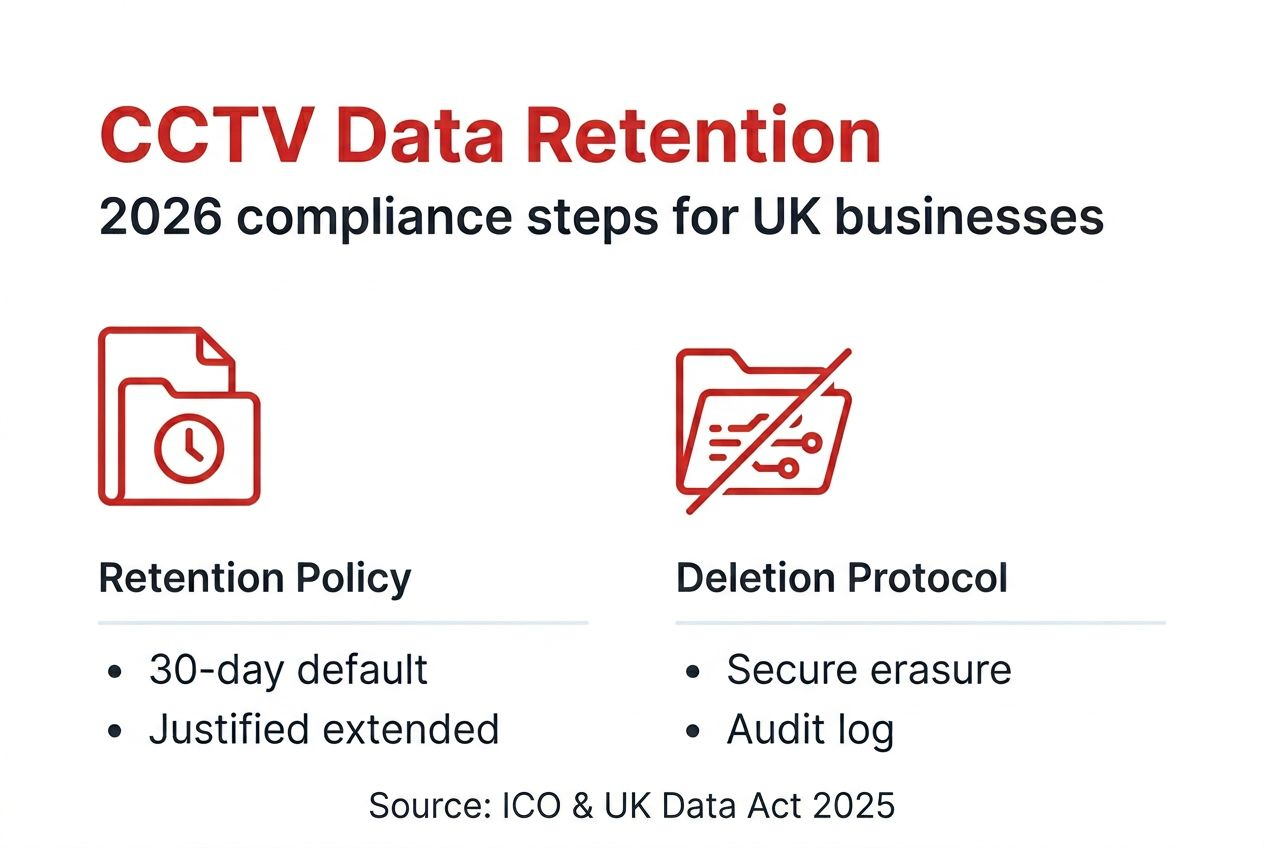
A typical 30-day retention period applies, with exceptions justified and retention/deletion documented and audited to ensure compliance. This timeframe balances security needs with data minimisation principles, allowing sufficient time to identify and investigate incidents whilst limiting unnecessary storage.
Extended retention requires specific justification. Ongoing investigations, legal proceedings, or insurance claims may necessitate keeping footage beyond 30 days. Document these exceptions carefully, noting why extended retention is necessary and when you will review the continued need. Blanket policies keeping all footage for six months or a year typically fail proportionality tests.
Secure deletion means footage cannot be recovered or accessed after the retention period expires. Simply pressing delete on a recording system may not suffice if backups or archived copies persist. Implement automated deletion where possible to remove human error from the process. CCTV retention policies should address both primary systems and any backup or cloud storage.
Documentation provides audit trails demonstrating compliance. Maintain logs showing when footage was deleted, who authorised retention beyond standard periods, and the justifications for any exceptions. This evidence protects you during ICO investigations or legal challenges.
Retention considerations by footage type:
| Footage Type | Standard Retention | Extended Retention Justification |
|---|---|---|
| Routine surveillance | 30 days | None, delete automatically |
| Incident capture | 30-90 days | Ongoing investigation or insurance claim |
| Evidence in legal matter | Until case resolution | Court proceedings or regulatory investigation |
| Health and safety event | 3 years | Potential personal injury claims statute |
Best practices include:
- Automated deletion after the retention period expires
- Clear procedures for extending retention with documented approval
- Regular audits confirming deletion processes function correctly
- Secure disposal of physical media containing archived footage
- Training staff on retention rules and exception procedures
Shorter retention periods reduce privacy risks, storage costs, and SAR response burdens. Only keep footage as long as genuinely necessary for your documented purposes.
Common misconceptions about CCTV data protection
Many business owners wrongly believe that using CCTV for security purposes creates an exemption from UK GDPR. No such exemption exists. Surveillance for crime prevention, property protection, or safety monitoring must still comply with data protection principles, transparency requirements, and individual rights provisions.
Another frequent misunderstanding involves ICO registration. Some assume only large organisations or public authorities must register as data controllers. Size does not determine registration requirements; the nature and scale of personal data processing does. A small business with extensive CCTV coverage may need registration whilst a larger company with minimal surveillance might not.
Subject access request timelines cause confusion. The one-month deadline is not a target; it is the maximum allowed timeframe. You should respond sooner when possible. Extensions to two or three months require valid complexity justifications, not simply convenience or workload pressures. The 2025 Act’s proportionality provisions do not extend deadlines; they clarify reasonable search scope.
Some operators mistakenly think that displaying “CCTV in operation” signs satisfies all transparency obligations. These generic notices fall short of UK GDPR requirements. You must provide specific information about purposes, data controller identity, and how to access your privacy notice. Vague signage creates compliance gaps.
Key misconceptions include:
- Security use exempts CCTV from data protection laws
- Only large businesses need ICO registration for CCTV
- One month is a suggested timeframe for subject access responses
- Generic CCTV signs meet transparency requirements
- You can use footage for any purpose once captured
- Storing footage indefinitely is acceptable for security archives
These misunderstandings lead to non-compliance, ICO penalties, and erosion of public trust. Investing time in proper education and policy development prevents costly mistakes.
Practical steps to achieve CCTV data protection compliance
Effective CCTV compliance integrates signage, data protection principles, retention policies, DPIAs, and staff training to maintain lawful surveillance. Moving from understanding requirements to implementation requires methodical planning and ongoing attention.
Start by assessing whether CCTV is necessary and proportionate for your specific security needs. Consider less intrusive alternatives before defaulting to surveillance. If you proceed with CCTV, document your decision-making process, including why cameras are essential and how coverage areas were selected. This legitimate interests assessment forms your compliance foundation.
Implementing compliant systems requires coordinating technical capabilities with legal obligations. Choose equipment that supports your retention policies through automated deletion, provides adequate footage quality for your purposes without being excessively intrusive, and includes security features protecting against unauthorised access. CCTV compliance checklist tools help ensure nothing gets overlooked.
Staff training is often neglected but critically important. Everyone who accesses CCTV footage must understand data protection principles, confidentiality obligations, and proper procedures for handling subject access requests or security incidents. Regular refresher training keeps compliance knowledge current as regulations evolve.
Essential implementation steps:
- Conduct a DPIA for new systems or significant changes to existing CCTV
- Install clear, compliant signage at all monitored areas before activation
- Configure systems with automated deletion at your documented retention period
- Create written policies covering retention, access controls, and SAR procedures
- Train all staff with CCTV access on their data protection responsibilities
- Schedule regular compliance reviews, at least annually or when regulations change
- Maintain documentation demonstrating ongoing compliance efforts
Pro Tip: Treat CCTV compliance as an ongoing process, not a one-time project. Schedule quarterly reviews of your policies, signage, and system configurations to catch issues before they become violations.
The ICO practical CCTV compliance guidance provides sector-specific examples and templates. Investing in proper implementation from the start costs less than fixing non-compliant systems after ICO intervention.
How we can help you with CCTV compliance in Essex and London
Navigating CCTV data protection requirements whilst maintaining effective security can feel overwhelming. You need surveillance systems that deter crime and protect your premises, but you also must comply with UK GDPR, the Data Protection Act 2018, and the Data (Use and Access) Act 2025.

Our CCTV installation services are designed around 2026 compliance requirements from the ground up. We configure systems with appropriate retention periods, implement automated deletion, and ensure camera placement balances security needs with privacy principles. Every installation includes compliant signage and documentation supporting your legitimate interests assessment.
Beyond installation, our CCTV compliance support helps you maintain ongoing conformity with evolving regulations. We assist with subject access request procedures, retention policy reviews, and staff training. Our CCTV security consultancy services provide tailored advice for businesses across Essex and London, ensuring your surveillance operations meet both security objectives and legal obligations. We understand local contexts and can design systems appropriate for your specific premises and risks.
Frequently asked questions
What is CCTV data protection and why does it matter?
CCTV data protection refers to securing personal data captured by surveillance systems in compliance with UK GDPR and related legislation. It matters because non-compliance risks ICO fines up to £17.5 million or 4% of global turnover, whichever is higher, plus reputational damage and legal challenges from affected individuals.
How long can I keep CCTV footage under UK law?
Standard retention for business CCTV footage is typically 30 days, providing sufficient time to identify security incidents whilst respecting data minimisation principles. Longer retention requires documented justification such as ongoing investigations, legal proceedings, or specific regulatory requirements, with regular reviews of continued necessity.
Do I need to register my CCTV system with the ICO?
ICO registration depends on whether your data processing qualifies as a fee-paying activity under Data Protection Act 2018 regulations. Most businesses using CCTV for security purposes must register, regardless of size. Check the ICO’s self-assessment tool to determine your specific obligations.
What information must CCTV signage include?
Compliant signage must state that CCTV operates in the area, explain the surveillance purpose, identify the data controller with contact details, and direct people to your full privacy notice. Signs must be clearly visible and readable before individuals enter monitored areas, using plain language that average visitors understand immediately.
Recommended
- Privacy and CCTV: Key Compliance for UK Businesses – 247 CCTV Security Ltd
- CCTV Compliance 2025 – What Every Care Home and Business Must Know – 247 CCTV Security Ltd
- Data Security in CCTV – What UK Facilities Managers Must Know – 247 CCTV Security Ltd
- Why Businesses Need CCTV: Complete Guide for 2025 – 247 CCTV Security Ltd