
Most british commercial properties risk fines or legal disputes if their CCTV footage is kept too long or not long enough. For facility and property managers in London and Essex, finding the right balance between security and compliance is rarely straightforward. This guide reveals the facts behind recording duration and debunks common CCTV myths, helping you make smarter decisions about video retention for your business.
Key Takeaways
| Point | Details |
|---|---|
| CCTV Recording Duration | Organisations must determine recording periods based on specific security needs and data protection compliance, not merely on retention duration. |
| CCTV System Types | Different CCTV systems have varied storage capabilities; organisations should choose systems that align with their unique operational needs. |
| Legal Compliance | Adhering to data protection laws is essential when managing CCTV footage, ensuring lawful processing and secure data handling. |
| Risks of Improper Management | Insufficient or excessive storage periods can lead to operational vulnerabilities and legal complications, necessitating regular policy reviews. |
Defining CCTV Recording Duration and Common Myths
CCTV recording duration represents the time video surveillance footage is retained, with operational strategies directly influenced by legal requirements and organisational needs. Recording duration is not a one-size-fits-all concept but a nuanced approach balancing security objectives and data protection regulations.

Many organisations misunderstand CCTV recording duration, believing longer retention automatically means better security. However, the Information Commissioner’s Office guidance clarifies that retention periods must be proportionate and justified. Businesses should determine recording duration based on specific security requirements, potential evidence needs, and compliance with data protection legislation.
Common misconceptions about CCTV recording duration include assumptions that all systems require identical storage periods. In reality, recording times vary substantially depending on factors like property type, risk level, and intended surveillance purpose. The National Security Inspectorate emphasises that optimal recording duration balances operational efficiency, storage capacity, and legal constraints.
Quick Security Tip: Regularly review and adjust your CCTV recording duration to ensure alignment with current security needs and data protection regulations.
Types of CCTV Systems and Storage Capabilities
CCTV technology has evolved significantly, offering diverse system types designed to meet specific security requirements. Modern surveillance systems range from traditional fixed cameras to advanced intelligent solutions, each with unique storage and recording capabilities that address different organisational needs.
The Information Commissioner’s Office highlights multiple CCTV system categories including body-worn video, fixed cameras, number plate recognition systems, and emerging smart camera technologies. These systems differ substantially in storage approaches, with options spanning from local device storage to complex networked Video Management Systems (VMS) that provide comprehensive footage management and analysis.
Storage capabilities depend on critical factors such as camera resolution, recording duration, and system architecture. High-definition network cameras typically require more sophisticated storage solutions compared to traditional analogue systems. Networked surveillance technologies offer flexible storage options, enabling businesses to scale their video retention capabilities according to specific security requirements and compliance regulations.
- Analogue systems: Limited local storage
- Digital network cameras: Scalable cloud and local storage
- Smart cameras: Advanced analytics with intelligent storage management
Pro Security Tip: Conduct a comprehensive security audit to determine the most appropriate CCTV system and storage strategy for your specific organisational requirements.
Here’s how common CCTV system types differ in storage and management capability:
| CCTV System Type | Storage Method | Scalability | Typical Use Case |
|---|---|---|---|
| Analogue cameras | Local device storage | Limited | Small businesses |
| Networked cameras | Local/cloud integrations | Highly scalable | Large organisations |
| Body-worn cameras | Docking/upload stations | Moderate | Security personnel |
| Smart cameras | Intelligent cloud systems | Flexible | Advanced analytics setups |
Key Factors Affecting Recording Duration Limits
Recording duration represents a critical intersection of technological capability, legal compliance, and operational security requirements. Understanding the complex factors influencing video retention helps organisations develop robust and legally compliant surveillance strategies.
The Information Commissioner’s Office guidance emphasises several key factors that directly impact recording duration limits. These include the specific purpose of surveillance, legal obligations, data protection principles, and the potential risks associated with extended video retention. Organisations must carefully evaluate the necessity and proportionality of their recording practices to ensure they are not retaining footage beyond what is strictly required.
Multiple technical and operational considerations influence recording duration limits. Storage capacity, camera resolution, compression technologies, and system architecture play crucial roles in determining how long footage can be practically and economically maintained. Networked surveillance standards recommend a balanced approach that considers:
- Operational requirements
- Legal compliance
- Storage infrastructure
- Data protection regulations
- Risk assessment outcomes
Pro Security Tip: Regularly review and adjust your CCTV recording duration to maintain a balance between comprehensive security coverage and data protection compliance.
UK Legal Requirements on Data Retention and Access
Data retention in CCTV surveillance represents a complex legal landscape that organisations must carefully navigate to ensure compliance with UK data protection regulations. The legal framework governing video surveillance demands a nuanced approach to managing personal data captured through security systems.
The Information Commissioner’s Office guidance provides comprehensive insights into the legal requirements surrounding CCTV data management. Under the UK GDPR and Data Protection Act 2018, organisations must adhere to strict principles that govern how surveillance footage is collected, stored, and accessed. This includes ensuring that video data is:
- Processed lawfully and transparently
- Collected for specific, explicit purposes
- Minimised to what is strictly necessary
- Stored securely and confidentially
- Retained only for as long as required
Detailed retention schedules mandate that organisations must document and justify their data storage periods. This requires a systematic approach to managing CCTV recordings, including clear protocols for:
- Documenting the purpose of data collection
- Establishing specific retention timeframes
- Implementing secure deletion processes
- Maintaining individual access rights
- Conducting regular compliance reviews
Pro Security Tip: Develop a comprehensive data retention policy that clearly outlines your CCTV recording management strategy and ensures ongoing legal compliance.
Risks of Insufficient or Excessive Storage Periods
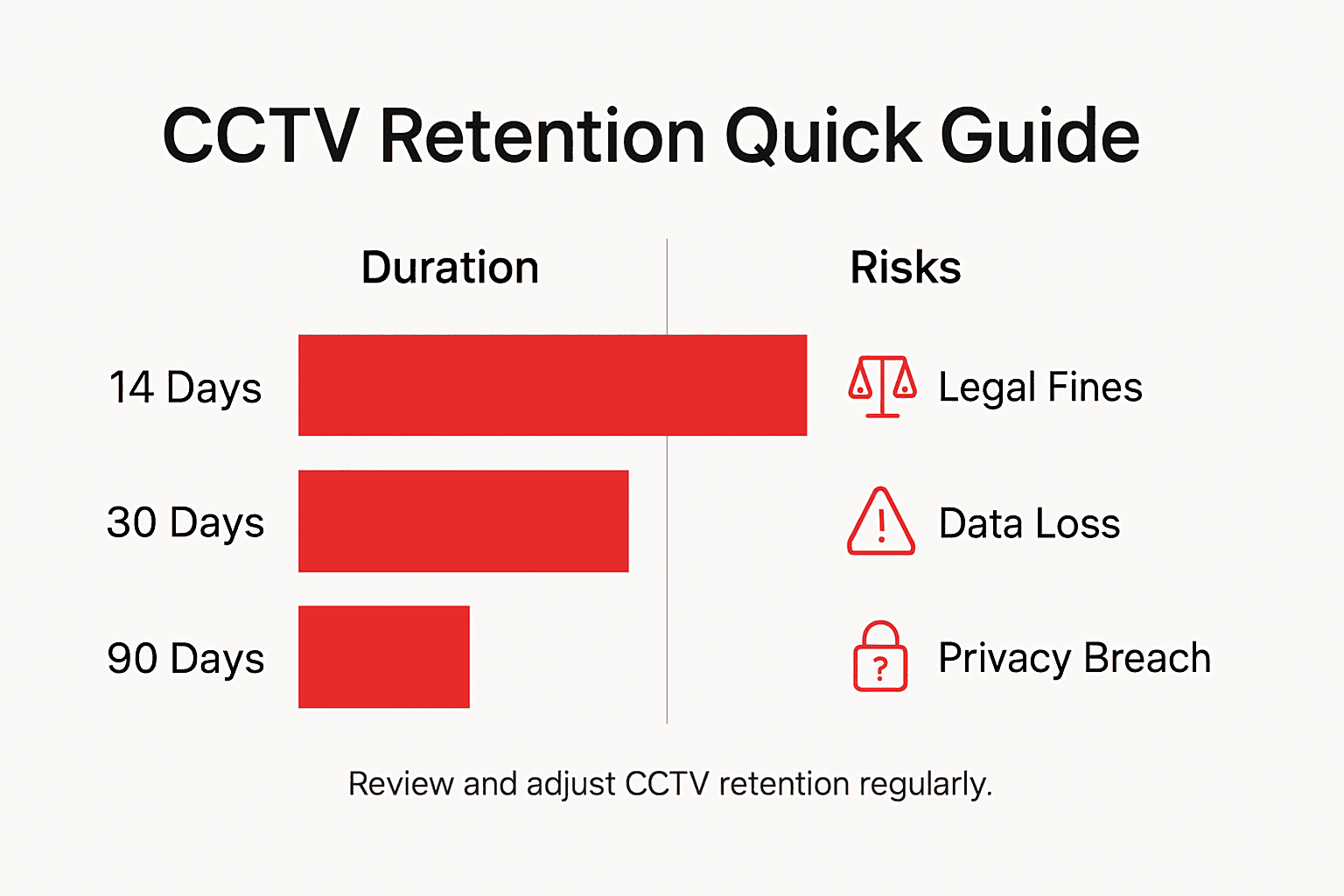
Storage period management represents a critical balancing act for organisations implementing CCTV surveillance systems. The potential risks associated with improper data retention can significantly impact an organisation’s legal compliance, operational effectiveness, and overall security strategy.
The Information Commissioner’s Office highlights multiple critical risks organisations face when mismanaging CCTV recording durations. Insufficient storage periods can lead to substantial operational vulnerabilities, including:
- Loss of critical forensic evidence
- Inability to investigate past incidents
- Compromised security response capabilities
- Reduced effectiveness of internal investigations
- Potential legal complications from incomplete documentation
Conversely, extended data retention presents equally significant challenges. Excessive storage periods expose organisations to heightened risks such as:
- Increased data protection compliance violations
- Higher potential for unauthorised data access
- Enhanced privacy breach vulnerabilities
- Greater administrative and storage management costs
- Potential reputational damage from inappropriate data handling
Pro Security Tip: Conduct quarterly reviews of your CCTV storage policy to ensure precise alignment between retention duration and actual operational requirements.
The table below summarises major risks arising from incorrect CCTV recording durations:
| Risk Type | Cause | Impact on Organisation |
|---|---|---|
| Loss of evidence | Too short retention period | Hinders incident response |
| Privacy breach | Excessive footage retention | Legal and reputational harm |
| Increased costs | Overextensive data storage | Higher operational expenses |
| Compliance failure | Ignoring schedule regulations | Potential fines and audits |
Secure Your CCTV Recording Duration with Expert Installation and Support
Ensuring your CCTV system retains footage for just the right time is vital for both compliance and security. This article highlights the challenges businesses face balancing legal data retention requirements and operational effectiveness. Many organisations struggle with questions such as how to avoid excessive storage that risks data breaches or too brief retention that jeopardises evidence. Our security installation solutions at 247cctv are designed to deliver tailored CCTV systems that precisely match your recording duration needs and meet UK data protection standards.

Take control of your video surveillance with a system expertly installed and configured to fit your organisation’s unique risks and compliance obligations. From sophisticated cameras to secure storage solutions we help you prevent privacy breaches, reduce unnecessary costs of over-storage, and ensure vital footage is always available. Start your journey towards peace of mind today by exploring our comprehensive services at 247cctv. Contact our team for a customised CCTV solution that ensures perfect compliance and powerful security now.
Frequently Asked Questions
What factors determine CCTV recording duration?
Recording duration is influenced by several factors including the specific purpose of surveillance, legal obligations, storage capacity, camera resolution, and data protection regulations. Organizations should assess these variables to set appropriate recording limits.
How does storage capacity affect CCTV recording duration?
Storage capacity plays a crucial role in determining how long CCTV footage can be retained. Higher resolution cameras generally require more storage space, which can limit the duration for which footage can be stored unless appropriate storage solutions are implemented.
Are longer CCTV recording durations always better for security?
No, longer recording durations do not automatically equate to better security. Retention periods must be proportionate to the specific security needs and legal compliance requirements of the organisation. Excessive retention may lead to privacy concerns and compliance issues.
What are the risks of insufficient or excessive storage periods for CCTV footage?
Insufficient storage can result in the loss of critical evidence and hinder investigations, while excessive storage can lead to data protection violations and increased costs. It’s essential for organisations to find a balance that meets their security needs and legal obligations.
Recommended
- Privacy and CCTV: Key Compliance for UK Businesses – 247 CCTV Security Ltd
- Complete Guide to the Role of CCTV Monitoring – 247 CCTV Security Ltd
- Data Security in CCTV – What UK Facilities Managers Must Know – 247 CCTV Security Ltd
- Complete Guide to the Role of CCTV in Security – 247 CCTV Security Ltd
- 7 Steps for a Rental Risk Management Checklist in South Africa – Rental Income Insurance